Friday
Friday: Inequalities All Around
Rocket reads the sign on the garage shelf. "Shelf holds at most 12 jars." He counts. "Ten. Can I add three?"
"Write it," Raven says. "What do you notice? 10 plus the new jars has to be at most 12."
"10 + x ≤ 12," Rocket says. "Subtract 10. x ≤ 2. Two jars, not three."
Nova glides along the shelf, her light on the sign. "Rules like that are everywhere," she says. "Shelves, timers, steps, jars of water."
"A timer with fewer than 5 minutes left," Raven says. "A jug that needs more than 2 cups to fill."
"Each one is a direction on the line," Rocket says. "Not one number." He puts two jars on the shelf and stops.
Nova hums. "Boundary respected."
Inequalities in everyday life
Shelves: 10 jars plus x more is at most 12. 10 + x ≤ 12, so x ≤ 2. Filled circle at 2, arrow left.
Timers: a block of t minutes has 3 minutes gone and more than 5 left. The rule t - 3 > 5 gives t > 8.
Jugs: 2 cups of water are in a jug and it needs more than 6 in all. 2 + c > 6, so c > 4.
Steps: 3 trips of s steps each and 4 extra steps make at least 40 steps. 3s + 4 ≥ 40, so s ≥ 12.
Equation or inequality?
If the rule says exactly, it is an equation with one solution. If it says more, less, at least or at most, it is an inequality.
An inequality has infinitely many solutions, shown by an arrow. The circle at the boundary is open for > and <, filled for ≥ and ≤.
- Read the question.
- Tap your answer.
- Read the question.
- Tap your answer.
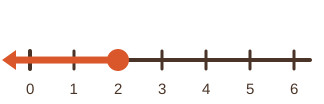 Which inequality does this number line show?
| Week review | True or false? |
|---|---|
| x > 4 has infinitely many solutions. | ? |
| "At most 12" is written x > 12. | ? |
| x = 2 makes 10 + x ≤ 12 true. | ? |
| An open circle means the boundary number is a solution. | ? |
| 2.5 < 3 | ? |
- ?We walked the floor number line and found that x > 4 has infinitely many solutions.
- ?We matched four words to four signs and graphed each with a circle and an arrow.
- ?We taped the line, called rules and tested where we stood.
- ?We solved the crew's two-step rule cards by undoing on both sides.
Write it as an inequality, solve it, and draw its number line.
A whole week of directions. Tomorrow is Puzzle Day: a walk-the-line game for your family.