Monday
Monday: Define the Problem
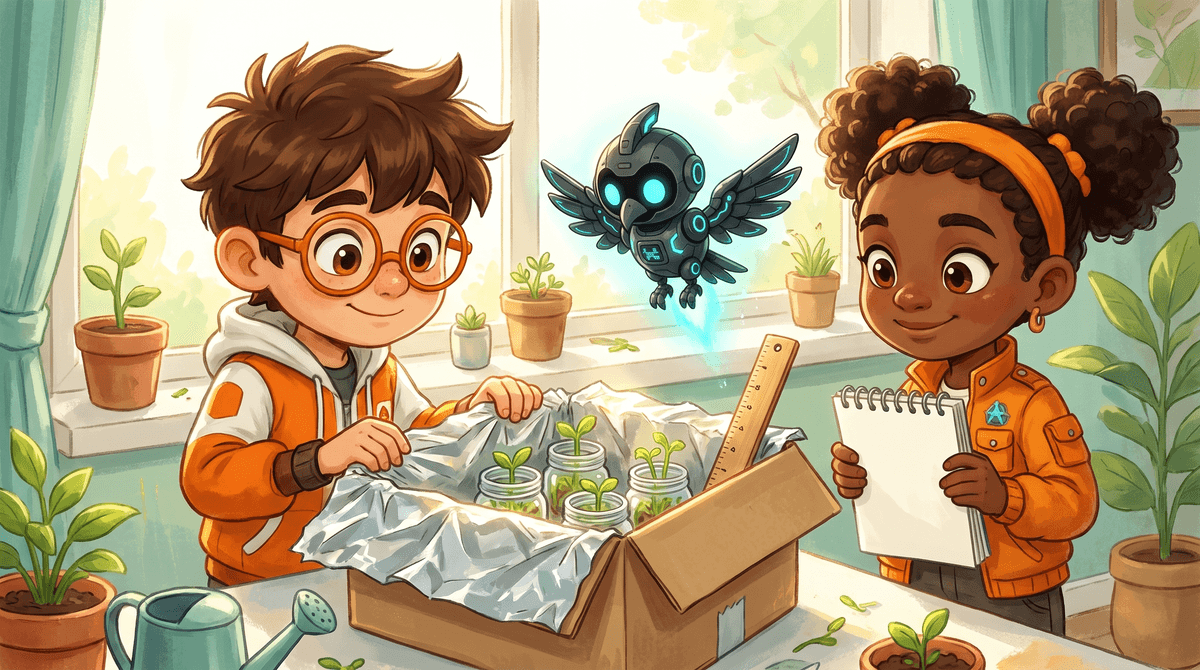
Rocket arrives at the Windowsill carrying an empty cardboard box, a roll of foil and a big grin.
"The sprouts lean toward the window every day," he says. "I am going to build them a sun palace."
Raven holds up a hand. "Before you build, say what the palace has to do. What do you notice about engineers?"
"They plan first," Rocket sighs. "Fine. It has to make the sprouts grow taller, greener and straighter."
Nova hovers over the box. "Good. Now say what it is not allowed to do," she says.
"Take up the whole sill. Use anything we do not already have. Need any light but the window." Rocket pauses. "That is a lot of rules."
"Those rules are the design problem," Raven says. "Write them down."
Criteria and constraints
Engineers start by defining a design problem. A design problem includes multiple criteria and constraints, including scientific knowledge that may limit possible solutions.
Criteria are what a successful solution must do. Constraints are the limits it must stay inside.
The more precisely a design task's criteria and constraints are defined, the more likely the designed solution will succeed.
Your design problem: build a windowsill growing station that helps the course sprouts grow better than a plain jar.
| Criteria (what it must do) | Constraints (limits it must respect) |
|---|---|
| Sprouts gain more height than in the plain jar | Fits in a space the size of a shoebox |
| Leaves stay green | Uses only materials already at home |
| Stems stand upright instead of leaning | Uses window light only, no lamps |
| Easy to measure every day | Tested for one week against the plain jar |
- Read the question.
- Tap your answer.
Why science belongs in the constraints
Defining constraints includes thinking about scientific principles and other knowledge that are likely to limit possible solutions.
You already know the science. Photosynthesis needs sunlight, carbon dioxide and water. Seedlings bend toward light. Growth depends on light, water, space and the kind of seed.
So a station cannot make sprouts grow without light or water, and it cannot turn a lentil into a bean plant.
Precise criteria and constraints are not rules for the sake of rules. They point you at designs that can actually work.
| Statement | True or false? |
|---|---|
| Criteria describe what a successful design must do. | ? |
| Constraints are limits such as space, materials and time. | ? |
| Scientific knowledge can limit which designs are possible. | ? |
| A precise design problem makes success less likely. | ? |
Gather what you may use: a cardboard box, foil, dark paper, tape, string, a small mirror, extra jars or cups.
Write your own design problem in your Windowsill Log, with at least three criteria and three constraints.
A grown-up does any cutting of cardboard. Mirrors and foil are never used to aim sunlight at anyone's eyes.
The engineering wording comes from the Next Generation Science Standards page for MS-ETS1 at nextgenscience.org.
Good planning. Tomorrow you use the science you know to sketch two possible designs.