Monday
Monday: Why Are Flowers Bright?
Raven sets a single flower from the garden in a cup of water on the Windowsill. Its petals are bright yellow.
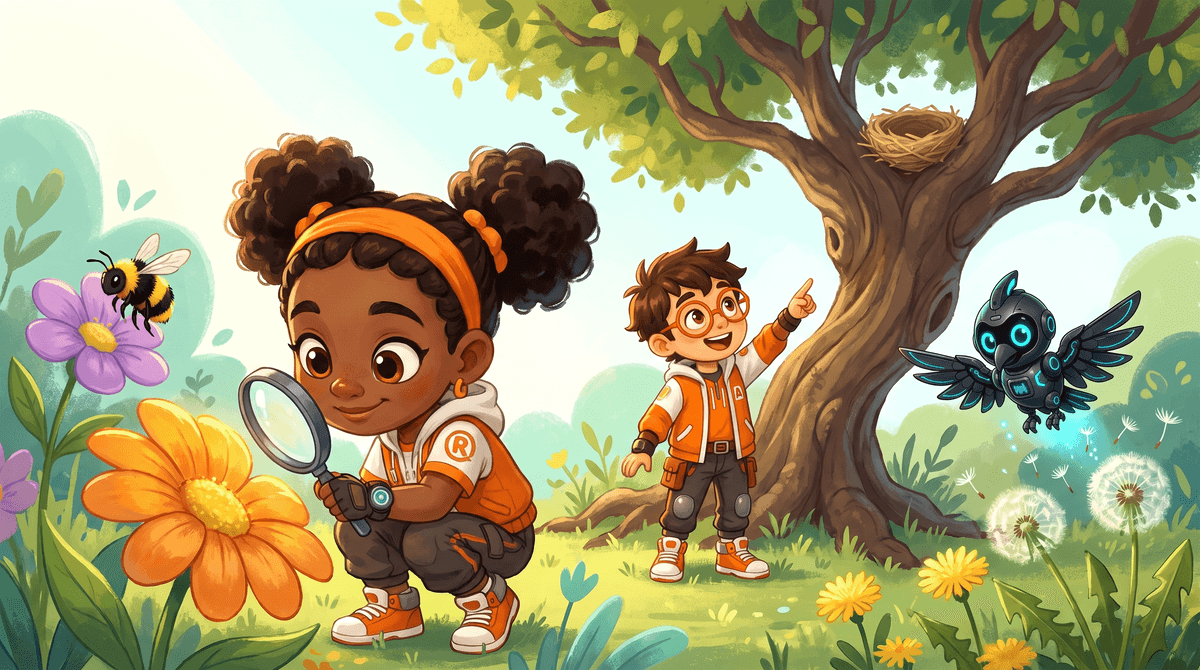
Rocket studies it through the hand lens. "There is yellow dust on these little stalks in the middle. And a bee was on it outside."
"What do you notice about the color?" Raven asks. "Why would a plant spend energy on bright petals?"
"To look nice?" Rocket guesses. Nova hovers over the cup, her light making the petals glow.
"Plants do not have eyes," she says. "So who is the color for?"
Rocket sits up. "The bee! The flower is a sign that says land here." Raven smiles. "And the dust is the reason why."
The parts of a flower
A typical flower has four rings of parts. The outermost ring is the sepals, green and leafy, which protect the unopened bud.
Inside the sepals are the petals, usually brightly colored.
Next come the stamens. Each is a long filament holding an anther at its tip, and pollen develops inside the anther.
In the center is the part that receives pollen. Its sticky top is the stigma. Pollination is the transfer of pollen from an anther to a stigma.
Pollen can land on the same flower or on another flower. When it reaches a stigma, the plant can go on to make seeds.
| Flower part | Where it is | Job |
|---|---|---|
| Sepals | Outermost ring, green | Protect the unopened bud |
| Petals | Second ring, usually bright | Attract pollinators |
| Stamens with anthers | Third ring | Make pollen |
| Stigma | Center, sticky top | Receives pollen |
- Read the question.
- Tap your answer.
Why bright, why scented
Scientists describe how specialized plant structures affect the probability of successful reproduction. Bright flowers attract butterflies that transfer pollen.
Flower nectar and odors attract insects that transfer pollen. The animal gets food. The plant gets its pollen carried to another flower.
Bees visit flowers that are open during the day, brightly colored, strongly scented and tube shaped.
Pollen sticks to the bee's fuzzy hair. When the bee visits another flower, some pollen rubs off onto it.
None of this guarantees a seed. It raises the chance. That word, chance, is the heart of this week.
| Statement | True or false? |
|---|---|
| Bright petals help attract animals that carry pollen. | ? |
| Nectar is a reward that brings insects to a flower. | ? |
| Pollen is carried on a bee's fuzzy hair. | ? |
| A bright flower guarantees the plant will make seeds. | ? |
Look with the hand lens. Find the petals, the sepals, the anthers with pollen and the sticky stigma.
Look only. Do not sniff the flower or touch your face, and wash your hands afterward.
Nests, insects and unknown plants are never touched. Flowers come from your own garden or from home.
Facts come from the free textbook Biology 2e and the Next Generation Science Standards page for MS-LS1-4.
Good looking. Tomorrow you meet the pollinators: bees, butterflies, moths, bats, birds and the wind.