Monday
Monday: Many Eyes See More
Rocket spreads twelve weeks of notebook pages across the workshop floor. "We saw so much!" he says.
Raven kneels and sorts the pages by date. "Every page has a date, a place and what we saw."
Nova hovers over the pile and glows. "Those are records," she says. "Scientists need records like these. More than they could ever make alone."
Rocket looks up. "You mean our notebooks could help real scientists?"
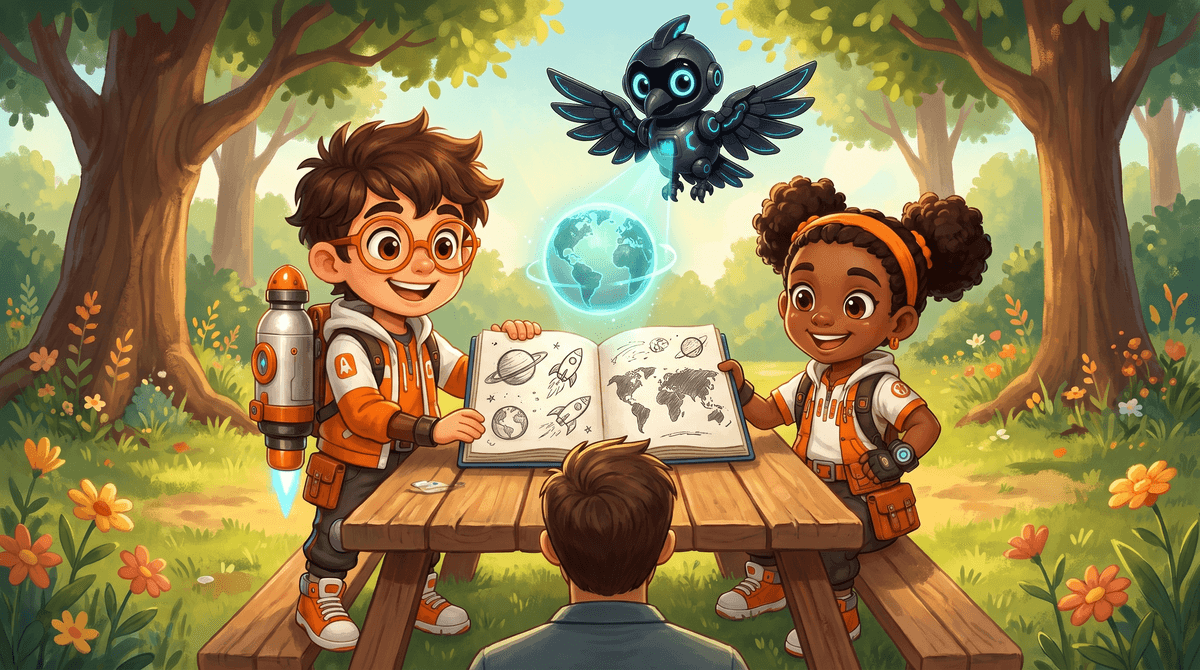
What a citizen scientist does
A citizen scientist is an everyday person who collects careful observations.
You do not need a lab or a degree. You need eyes, a notebook and honesty.
Scientists cannot be everywhere. One scientist can watch one park on one day.
Thousands of people can watch thousands of yards, parks and sidewalks every day.
When those people share what they see, scientists get a picture nobody could make alone.
You have been doing this for twelve weeks. Every notebook page with a date is a record.
What makes a good record
A good sighting record answers five questions.
| Question | Example | Why it matters |
|---|---|---|
| What did you see? | a small brown bird with a striped chest | so others know which living thing it was |
| Where? | the hedge by the park creek path | so the record can go on a map |
| When? | the date and the time of day | so the record can be counted by month |
| How many? | three | so counts can be compared |
| How sure are you? | very sure, or not sure | so scientists know how much to trust it |
- Read the question.
- Tap your answer.
| Statement | True or false? |
|---|---|
| You need a lab to be a citizen scientist. | ? |
| A good record includes the date. | ? |
| It is fine to leave out the place where you saw something. | ? |
| Saying "I am not sure" makes a record more honest. | ? |
Make one full record: what, where, when, how many, how sure.
Read it aloud. Could a stranger understand it without asking you anything?
Look with your eyes. Never touch a wild animal, nest, egg, mushroom or unknown plant.
Wash your hands when you come back in.
You are already a citizen scientist! Tomorrow we follow a record from a notebook to the whole world.