Thursday
Thursday: The Mirror Graph
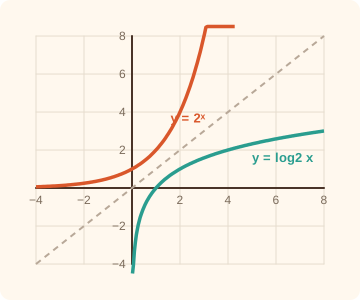
Wren pins two sheets of graph paper to the chalkboard wall. On the left, y = 2ˣ climbs away.
"Now swap every x and y," he says. "(0, 1) becomes (1, 0). (3, 8) becomes (8, 3). What do you notice?"
Comet plots the swapped points. "It is the same curve lying on its side. It climbs, but slowly."
"That is y = log₂ x," Wren says. "The inverse of 2ˣ. Each undoes the other."
Nova draws a dashed line from corner to corner. "Would you like a hint? Fold along y = x."
"They match," Comet says, folding the paper. "A mirror. So log₂ 8 = 3 because 2³ = 8."
"And the log curve never touches the y-axis," Wren says. "No power of 2 is zero or negative."
An inverse function
A function and its inverse undo each other. f(x) = 2ˣ sends 3 to 8. Its inverse sends 8 back to 3.
The inverse of y = 2ˣ is y = log₂ x. Swapping x and y in a table gives the inverse's table.
On a graph, swapping x and y is a reflection across the line y = x. The two curves are mirror images.
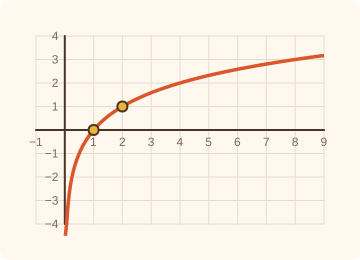
Key features of y = log₂ x
- It passes through (1, 0), because 2⁰ = 1. Every log graph does, whatever the base.
- It passes through (2, 1), because 2¹ = 2. In general it passes through (b, 1).
- It is only drawn for x greater than 0. A power of 2 is never zero or negative, so log₂ 0 has no value.
- It rises forever, but more and more slowly. Doubling x adds only 1 to y.
Shift, stretch and flip
The moves from Algebra 1 still work. The rule g(x) = log₂ x + 3 lifts every point up 3.
The rule g(x) = log₂(x - 2) slides the graph right 2. The rule g(x) = 2 log₂ x stretches it taller.
The rule g(x) = -log₂ x flips it over the x-axis.
For example, log₂ 8 + 3 = 6, log₂(10 - 2) = 3, and 2 log₂ 16 = 8.
Why log₂(M × N) = log₂ M + log₂ N
Here is the rule Tuesday's method leaned on, proved in six steps. Read it first, then put it in order below.
- Let m = log₂ M and n = log₂ N. These are exponents.
- Then M = 2ᵐ and N = 2ⁿ, by the meaning of a logarithm.
- Multiply: M × N = 2ᵐ × 2ⁿ.
- Same base, so add the exponents: M × N = 2ᵐ ⁺ ⁿ.
- Read the power sentence as a log sentence: log₂(M × N) = m + n.
- Replace m and n: log₂(M × N) = log₂ M + log₂ N.
Check it with numbers: log₂ 8 + log₂ 16 = 3 + 4 = 7, and log₂ 128 = 7. The same rule, used k times, gives log₂(Mᵏ) = k log₂ M.
- ?Multiply: M × N = 2ᵐ × 2ⁿ
- ?So M = 2ᵐ and N = 2ⁿ
- ?Add the exponents: M × N = 2ᵐ ⁺ ⁿ
- ?Replace m and n: log₂(M × N) = log₂ M + log₂ N
- ?Let m = log₂ M and n = log₂ N
- ?Write it as a log: log₂(M × N) = m + n
- Read the question.
- Tap your answer.
| Statement | True or false? |
|---|---|
| The graph of y = log₂ x passes through (1, 0). | ? |
| The graph of y = log₂ x crosses the y-axis. | ? |
| y = log₂ x + 3 is the graph of y = log₂ x moved up 3. | ? |
| y = log₂(x - 2) is the graph of y = log₂ x moved left 2. | ? |
| Reflecting y = 2ˣ across the line y = x gives y = log₂ x. | ? |
Clear reasoning. Tomorrow the whole week comes back in a mixed set from the Glass House log.