Monday
Monday: The Duckweed Count
A few green specks float in the water trough by the back wall. Comet counts them with a pencil tip.
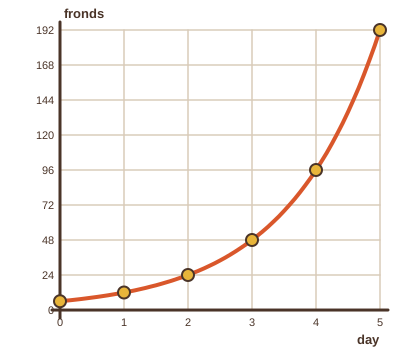
"Six duckweed fronds. Nova, log it." The next morning she counts again. "Twelve." The morning after: "Twenty-four."
Wren reads the log over her shoulder. "What do you notice? Not plus six each day."
"Times two each day," Comet says. "Six, twelve, twenty-four. Tomorrow should be forty-eight."
Nova projects the counts as rising dots on the glass. "Would you like a hint? Write the count after d days as one rule."
"Six times two to the d," Comet says. "An exponential function. Our own model, from our own counts."
"Then when does it cover the trough?" Wren asks. "That is this week's question, and next week's too."

An exponential function from a table
The crew's counts are 6, 12, 24, 48. Each day's count is the day before times 2. The pattern is multiply, not add.
So the rule is N(d) = 6 × 2ᵈ: start at 6 and multiply by 2 once for each day. This is the crew's model from their own counts, not a fact about any plant.
Check it: N(3) = 6 × 2³ = 6 × 8 = 48. It matches the log.
A linear rule adds the same amount each step. An exponential rule multiplies by the same factor each step.
A solved problem to study: the rule from two counts
- Two readings from the log: day 1 had 12 fronds and day 3 had 48.
- From day 1 to day 3 is 2 days. The count was multiplied by 48 ÷ 12 = 4 over those 2 days.
- So the daily factor r satisfies r² = 4, which gives r = 2.
- Run back one day from day 1: the day 0 count is 12 ÷ 2 = 6. The rule is N(d) = 6 × 2ᵈ.
The crew's trough log
Every row is the crew's own count from Nova's log, made up for the Glass House.
| Day d | Count N(d) = 6 × 2ᵈ | Times the day before |
|---|---|---|
| 0 | 6 | start |
| 1 | 12 | × 2 |
| 2 | 24 | × 2 |
| 3 | 48 | × 2 |
| 4 | 96 | × 2 |
| 5 | 192 | × 2 |
- Read the question.
- Tap your answer.
- Read the question.
- Tap your answer.
| Statement | True or false? |
|---|---|
| In N(d) = 6 × 2ᵈ, the 2 is the growth factor. | ? |
| 6 × 2 × 2 × 2 = 48 | ? |
| 6 × 2 × 5 = 192 | ? |
| An exponential rule adds the same amount each step. | ? |
| The counts 6, 12, 24, 48 come from an exponential rule. | ? |
Write the layer count as a rule in the number of folds. Is it linear or exponential?
Strong start. Tomorrow you rewrite the rule to read its rate by the day or by the week.