Friday
Friday: Parabolas All Around
Comet tosses a rubber ball across the Loft to Wren. "That was a parabola."
"Every throw is," Wren says, catching it. "Up, over the top, down. What do you notice about the water from the hose?"
Outside, the garden hose arcs water onto the grass. "Another one," Comet says. "Vertex in the air, intercept on the lawn."
"A bouncing ball draws a whole row of them, each one lower," Wren says.
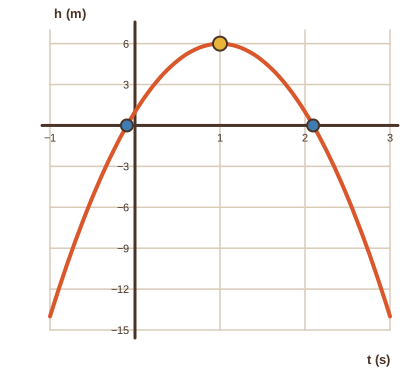
Nova projects a graph of a ball thrown upward: h(t) = -5t² + 10t + 1. "Would you like a hint? Where does this one start?"
"At 1 meter, from a hand," Comet says. "The h-intercept is c. The vertex is at t = 1, height 6."
"Review time," Wren says. "Then next week we fit lines to our Fair Day data."
Where parabolas live
A thrown ball, water from a hose, a jump over a rope: anything that goes up and comes down traces a parabola.
The Loft ball: h(t) = -5t² + 10t + 1, tossed from a hand at 1 meter. The vertex is (1, 6).
It lands when h = 0. The solutions of -5t² + 10t + 1 = 0 are about -0.1 and 2.1. Only the positive one is a landing.
All these numbers are the crew's own Loft examples, written to practice the shapes, not measurements of real throws.
The week in five lines
- A quadratic function graphs as a parabola. It opens up when a is positive and down when a is negative.
- The vertex is the maximum or minimum. The axis of symmetry runs through it.
- Graph by hand from a table or from vertex form. Complete the square to find the vertex.
- Standard form shows the y-intercept, vertex form shows the vertex, factored form shows the x-intercepts.
- f(x) + k, k f(x), f(x + k) and f(kx) shift, stretch, flip and squeeze the graph in predictable ways.
- Read the question.
- Tap your answer.
- Read the question.
- Tap your answer.
| Statement | True or false? |
|---|---|
| The axis of symmetry passes through the vertex. | ? |
| In y = ax² + bx + c, the number c is the y-intercept. | ? |
| Vertex form shows the x-intercepts directly. | ? |
| f(x) - 3 slides the graph down by 3. | ? |
| -5 × 1 × 1 + 10 × 1 + 1 = 6 | ? |
Toss it higher. Say which transformation you just made.
Terrific week. You can graph any quadratic and read its story. Tomorrow is Loft Day.