Monday
Monday: Slide the Tiles Into a Rectangle
Comet tips a bag of tiles onto the bench: one x squared, five strips, six units. "This week we go backwards."
"x squared plus 5x plus 6," Wren reads. "What rectangle made these? What do you notice about the units?"
"Six units," Comet says. "They have to fill a corner. A 1 by 6 corner, or a 2 by 3 corner."
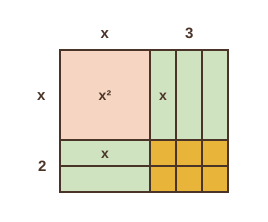
She slides the units into a 2 by 3 block and lays the strips around the big square. Two down, three along.
Nova hovers over the rectangle, her light running along both edges. "Would you like a hint? Read the sides."
"x + 2 and x + 3," Wren says. "So x squared plus 5x plus 6 equals (x + 2)(x + 3). Factoring undoes multiplying."
"Our engineer," Comet says, "the next bag holds x squared, seven strips and twelve units. What rectangle do they make?"

Factoring undoes the area model
Last week two sides gave a polynomial. This week a polynomial gives back its two sides. That is factoring.
A solved example to study: x² + 5x + 6. The units, 6, must form a corner. The strips, 5, split between two sides.
Two numbers that multiply to 6 and add to 5: 2 and 3. So the sides are x + 2 and x + 3.
Check by multiplying back: (x + 2)(x + 3) = x² + 5x + 6. The tiles and the algebra agree.
The two-number search
- Write the polynomial as x² + bx + c. Note b, the strips, and c, the units.
- List the pairs of numbers that multiply to c.
- Pick the pair that adds to b.
- Write the sides: (x + first number)(x + second number).
- Multiply back to check.
| Polynomial | c (units) | b (strips) | The pair | Factored form |
|---|---|---|---|---|
| x² + 5x + 6 | 6 | 5 | 2 and 3 | (x + 2)(x + 3) |
| x² + 7x + 12 | 12 | 7 | 3 and 4 | (x + 3)(x + 4) |
| x² + 6x + 8 | 8 | 6 | ? | ? |
| x² + 8x + 15 | 15 | 8 | ? | ? |
- Read the question.
- Tap your answer.
Which is the factored form of x² + 5x + 6?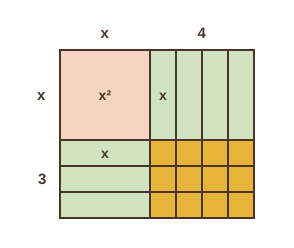 Which is the factored form of x² + 7x + 12?
- Read the question.
- Tap your answer.
| Statement | True or false? |
|---|---|
| x² + 5x + 6 = (x + 2)(x + 3) | ? |
| x² + 7x + 12 = (x + 2)(x + 6) | ? |
| x² + 6x + 8 = (x + 2)(x + 4) | ? |
| The unit tiles must form a rectangular corner for the big rectangle to close. | ? |
| Factoring and multiplying are opposite moves. | ? |
Read the sides, then multiply back on paper to check.
Pick the small tiles up at the end so nobody slips on them.
Clean reversal. Tomorrow four kinds of factoring, and the rule that comes first every time: pull out the common factor.