Monday
Monday: Tiles for the Launch Pad
Comet spreads cardboard tiles across the bench: a big square, long strips, small squares.
"The launch pad is a square, x by x," she says. "But the launcher is not built, so I do not know x yet."
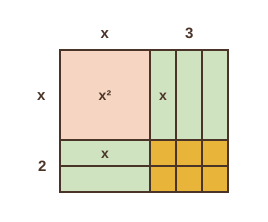
"Then build the plan with tiles," Wren says. "The big square is x by x. A strip is x by 1. A small square is 1 by 1."
He lays a rectangle: the big square, five strips, six small squares. "Sides x + 2 and x + 3. What do you notice?"
Nova hovers over the layout, her light sorting the tiles by kind. "Would you like a hint? Count each kind separately."
"One x squared, five x, six ones," Comet reads. "So the area is x squared plus 5x plus 6."
"A polynomial," Wren says. "Our engineer, how many of each tile does (x + 1)(x + 4) need?"

Three kinds of tiles
- The x² tile is a square with sides x. Its area is x times x, written x².
- The x tile is a strip x long and 1 wide. Its area is x.
- The unit tile is a 1 by 1 square. Its area is 1.
- Nobody knows x yet. The tiles keep the plan honest for whatever x turns out to be.
A polynomial
A polynomial is a sum of terms. Each term is a number times a power of x. In x² + 5x + 6, the terms are x², 5x and 6.
The number in front of a term is its coefficient. The coefficient of x in x² + 5x + 6 is 5.
The degree is the highest power. x² + 5x + 6 has degree 2. A plain number like 6 has degree 0.
A solved example to study: the Monday rectangle has sides x + 2 and x + 3. Its tiles are 1 x², 5 x and 6 units, so (x + 2)(x + 3) = x² + 5x + 6.
| Expression | Terms | Degree | Coefficient of x |
|---|---|---|---|
| x² + 5x + 6 | 3 | 2 | 5 |
| 2x² + 3x + 1 | 3 | 2 | 3 |
| x³ + 2x | 2 | 3 | 2 |
| 4x - 7 | 2 | 1 | 4 |
| 9 | 1 | 0 | 0 |
- Read the question.
- Tap your answer.
Which expression equals (x + 2)(x + 3)?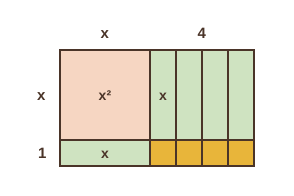 Which expression equals (x + 1)(x + 4)?
- Read the question.
- Tap your answer.
| Statement | True or false? |
|---|---|
| The degree of x² + 5x + 6 is 2. | ? |
| The degree of x³ + 2x is 2. | ? |
| (x + 2)(x + 3) = x² + 5x + 6 | ? |
| (x + 2)(x + 3) = x² + 6 | ? |
| An x tile is x long and 1 wide, so its area is x. | ? |
Lay out (x + 1)(x + 2). Count the tiles of each kind and write the polynomial.
Scissors stay closed when you are not cutting, and a grown-up cuts anything thick.
Clear counting. Tomorrow the crew adds, subtracts and multiplies polynomials, and finds that the answer is always another polynomial.