Monday
Monday: The Strip That Doubles
Comet unrolls a long strip of paper across the Loft floor. "New week, new build. What can we make with one strip?"
She folds it in half. "Two layers." Again. "Four." Again. "Eight. Wren, what do you notice?"
"Each fold doubles the layers," Wren says. "Last week the cup tower added three cups a row. This multiplies."
"So after ten folds it is huge?" Comet asks, already folding a fifth time. The strip fights back.
Nova hovers over the fold, her light drawing a small table in the air. "Would you like a hint? Count folds and layers side by side."
"Zero folds, one layer. One fold, two. Two folds, four," Wren reads. "Powers of two."
Comet looks at you. "Our engineer, how many layers after six folds? And why can I not fold it a seventh time?"

Adding or multiplying
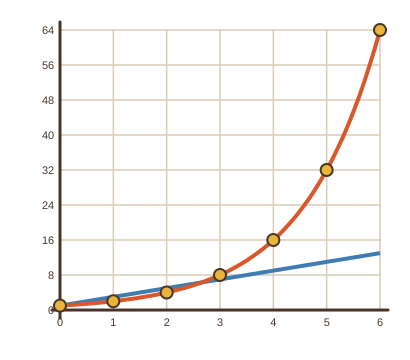
A linear function adds the same amount every step. The cup tower added 3 cups a row.
An exponential function multiplies by the same factor every step. The strip multiplies its layers by 2 at every fold.
The crew's rule is L(n) = 2n: after n folds there are 2n layers. The 2 is the growth factor.
A solved example to study: L(6) = 2⁶ = 2 × 2 × 2 × 2 × 2 × 2 = 64. Six factors of 2, not 2 × 6.
| Folds n | Layers L(n) | How it got there |
|---|---|---|
| 0 | 1 | the flat strip |
| 1 | 2 | 1 × 2 |
| 2 | 4 | 2 × 2 |
| 3 | 8 | 4 × 2 |
| 4 | 16 | 8 × 2 |
| 5 | 32 | 16 × 2 |
| 6 | 64 | 32 × 2 |
Words for the week
- In 2n, 2 is the base and n is the exponent. The exponent counts the factors of 2.
- The growth factor is the number you multiply by each step. For the strip it is 2.
- Linear change: equal differences from step to step. Exponential change: equal ratios from step to step.
- A table tells you which. Subtract neighbors for the differences, divide neighbors for the ratios.
- Read the question.
- Tap your answer.
- Read the question.
- Tap your answer.
| Statement | True or false? |
|---|---|
| 2⁶ = 64 | ? |
| 2⁵ = 10 | ? |
| 2 × 2 × 2 × 2 = 16 | ? |
| An exponential function multiplies by the same factor every step. | ? |
| Doubling layers at every fold is a linear pattern. | ? |
Write the folds and layers as a table. Check that each layer count is double the one before.
Keep fingers clear of the sharp crease edge, and use tape, not teeth, to hold a fold.
Strong start. Tomorrow the rules of exponents stretch to fractions, and roots turn out to be powers in disguise.