Thursday
Thursday: Constraints and the Region of Good Builds
Comet spreads cardboard fins and straw struts across the bench. "Launcher parts. How many of each can we use?"
"Two limits," Wren says. "At most 20 parts in total, so the base stays light. And at least 2 struts per fin."
"That is not two equations," Comet says. "That is two inequalities. x + y ≤ 20 and y ≥ 2x."
Nova projects the first line, x + y = 20, then shades everything below it. "Would you like a hint? Test a point."
"(4, 10): 4 + 10 is 14, under 20. Good. And 10 is at least 8. Good." Comet marks the dot.
"Now (8, 14)," Wren says. "22 parts. Too many. What do you notice? It lands outside the shaded part."
"So the overlap is the region of good builds," Comet says. "Our engineer, which options work?"
From limits to inequalities
A constraint is a limit on a build. Write it as an inequality in the two counts.
Fins x and struts y. At most 20 parts: x + y ≤ 20. At least 2 struts per fin: y ≥ 2x.
Counts are whole numbers and never negative, so x ≥ 0 and y ≥ 0 too.
Graphing one inequality
- Graph the boundary line as if it were an equation. For x + y = 20 that is y = 20 - x.
- Draw it solid for ≤ or ≥ (points on the line count) and dashed for < or > (they do not).
- Test one point not on the line, such as (0, 0). If it makes the inequality true, shade its side.
- Every point in the shaded half-plane is a solution. For a system, shade each one and keep the overlap.
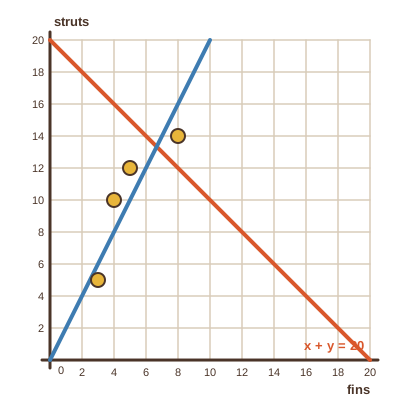
The good builds sit below x + y = 20 and above y = 2x: the wedge between the two lines.
(4, 10) and (5, 12) are inside. (8, 14) breaks the parts limit. (3, 5) has too few struts.
The crew's option table
The crew listed six builds they were thinking about. Every count is their own.
| Option (fins, struts) | Parts (x + y) | Struts at least 2x? | Viable? |
|---|---|---|---|
| (4, 10) | 14 | yes | yes |
| (5, 12) | 17 | yes | yes |
| (6, 11) | 17 | no | no |
| (8, 14) | 22 | no | no |
| (3, 5) | 8 | no | no |
| (7, 14) | 21 | yes | no |
- Read the question.
- Tap your answer.
- Read the question.
- Tap your answer.
| Statement | True or false? |
|---|---|
| (5, 12) satisfies x + y ≤ 20 and y ≥ 2x. | ? |
| (7, 14) satisfies x + y ≤ 20 and y ≥ 2x. | ? |
| (6, 11) satisfies x + y ≤ 20 and y ≥ 2x. | ? |
| A solid boundary line means points on the line are solutions. | ? |
| The solutions of a system of inequalities are where the shaded regions overlap. | ? |
| 7 + 14 > 20 | ? |
Sharp reasoning, engineer. Tomorrow you meet systems in everyday life and review the week.