Monday
Monday: Two Carts, One Meeting Point
Comet lines up two planks side by side on the sawhorses. "Two tracks. Cart A gets a head start of 40 centimeters."
"Cart B starts at the line but rolls faster," Wren says. "A does 20 a second, B does 30. Our Monday timings."
"Where does B catch A?" Comet asks. "What can we make to find out?"
Wren writes two rules. "A: y = 20x + 40. B: y = 30x. x is seconds, y is centimeters. What do you notice?"
"Two equations. We want the one moment when both y values are equal."
Nova projects both lines on one grid. They cross at a single point. "Would you like a hint? Read where they meet."
"Four seconds, 120 centimeters," Comet says. "20 × 4 + 40 is 120, and 30 × 4 is 120. Both true!"
"A system of equations," Wren says. "Our engineer, help us check it."

A system and its solution
Two equations that must both be true at once are a system. Cart A is y = 20x + 40 and cart B is y = 30x.
Each equation draws a line. The lines cross at (4, 120): after 4 seconds both carts are 120 centimeters down the track.
Check: 20 × 4 + 40 = 120 and 30 × 4 = 120. Both true, so (4, 120) is the solution of the system.
Any other point fails at least one equation. (0, 40) is on A's line but not B's.
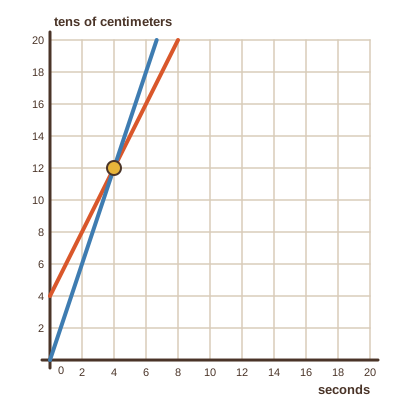
The graph is drawn in tens of centimeters so both lines fit. The scale is written on the axis.
Why the crossing point
The graph of an equation is every pair (x, y) that makes it true. A line is all of its solutions at once.
A point on both lines makes both equations true. So the crossing point is the one pair that solves both.
The x of the crossing is also the solution of 20x + 40 = 30x. Both rules give the same y there, so set them equal.
A solved problem to study
- Set the two y rules equal: 20x + 40 = 30x.
- Subtract 20x from both sides: 40 = 10x.
- Divide by 10: x = 4.
- Put x back into either rule: y = 30 × 4 = 120.
- Check the pair (4, 120) in both equations.
- Read the question.
- Tap your answer.
- Read the question.
- Tap your answer.
| Statement | True or false? |
|---|---|
| The solution of a system is the point where the two lines cross. | ? |
| (4, 120) is a solution of y = 20x + 40 and y = 30x. | ? |
| (0, 40) is a solution of y = 20x + 40 and y = 30x. | ? |
| (2, 80) is a solution of y = 20x + 40. | ? |
| 20 × 4 + 40 = 30 × 4 | ? |
Read the crossing point. Then check it in both equations.
Strong start, engineer. Tomorrow you solve systems three ways and learn why elimination is allowed.