Thursday
Thursday: The Crew's Loft Data
Wren unrolls a long string of paper flags across the bench. "For the fair booth. I taped one every 4 centimeters."
Comet measures. "The first flag is at 5 centimeters, not zero. Then 9, 13, 17."
"A sequence," Wren says. "What do you notice about term 1 and the step?"
"Start 5, add 4. So flag n is at 4n + 1." She checks flag 3: 13. "Yes."
Nova projects a second table beside it. "Would you like a hint? This pitcher started with more water and filled faster."
"100 at the start, up 60 each minute," Wren reads. "P = 60t + 100."
"Two rules, two stories," Comet says. "Our engineer, read the tables and say what each number means."
The crew's Thursday tables
All of these are the crew's own made-up measurements from the Loft, in centimeters and milliliters.
| Flag number (n) | Position (centimeters) |
|---|---|
| 1 | 5 |
| 2 | 9 |
| 3 | 13 |
| 4 | 17 |
| 5 | 21 |
| 6 | 25 |
| Minutes (t) | Jug A (milliliters) | Pitcher B (milliliters) |
|---|---|---|
| 0 | 200 | 100 |
| 1 | 240 | 160 |
| 2 | 280 | 220 |
| 3 | 320 | 280 |
| 4 | 360 | 340 |
Flags: a(n) = 4n + 1, or a(1) = 5, a(n) = a(n - 1) + 4. The 4 is the spacing, the 1 is the offset of the first flag.
Pitcher B: P = 60t + 100. Its slope 60 beats jug A's 40, so B fills faster. Its intercept 100 is below A's 200.
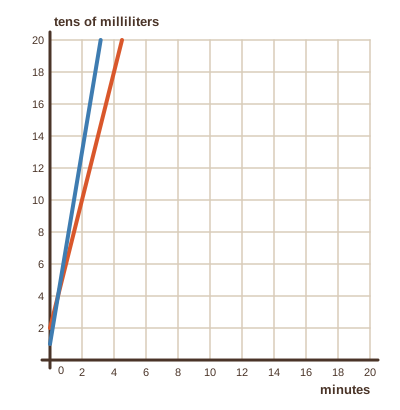
The graph is drawn in tens of milliliters so both lines fit. The steeper line is the faster fill.
- Read the question.
- Tap your answer.
- Read the question.
- Tap your answer.
| Statement | True or false? |
|---|---|
| Pitcher B starts with more water than jug A. | ? |
| Pitcher B fills faster than jug A. | ? |
| In the sequence starting 5 and adding 4, term 7 is 29. | ? |
| In the sequence starting 5 and adding 4, term 12 is 50. | ? |
| The flag string is an arithmetic sequence. | ? |
| 60 × 4 + 100 = 340 | ? |
- Read the question.
- Tap your answer.
Sharp reading, engineer. Tomorrow you find sequences and linear models in everyday life and review the week.