Friday
Friday: Functions All Around
Comet points at the Loft thermostat. "Set a temperature, get one fan speed. Function."
"The light switch," Wren adds. "Up gives on, down gives off. One input, one output."
"An elevator," Comet says. "Press one button, you reach one floor. Press the same button, same floor."
Nova projects a graph on the wall, a smooth curve rising and falling. "Would you like a hint? Is this a function?"
"Every x across has one height," Wren says. "A vertical line touches it once. Yes."
She swaps it for a sideways loop. A vertical line crosses it twice. "Not a function," Comet says. "Two outputs."
"What do you notice?" Wren says. "The test is the same everywhere. One input, exactly one output."
Functions in everyday life
- A thermostat: each set temperature gives one fan setting.
- A light switch: each position gives one state, on or off.
- An elevator button: each button gives one floor, every time.
- A countdown timer: each second that passes gives one time left.
Graphs that are functions
The graph of a function is the graph of y = f(x). Each x across has exactly one height y.
The vertical line test: slide an imaginary vertical line across the graph. If it ever touches two points, the graph is not a function.
The cart line y = 40t passes the test. A sideways loop fails it.
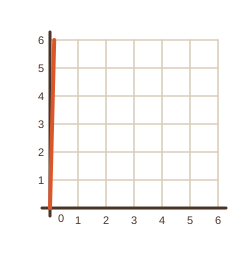
On this grid the cart line is steep because the output grows by 40 for every 1 across. Scale the up axis in centimeters to read it.
The week in five lines
- A function gives exactly one output for each input in its domain.
- The domain is the set of inputs; the range is the set of outputs.
- f(x) names the output of f at x. f(3) = 11 means 3 goes in and 11 comes out.
- The situation sets the domain: whole rows of cups, 0 to 6 seconds on the plank.
- A table, diagram or graph is a function only if no input has two outputs.
- Read the question.
- Tap your answer.
- Read the question.
- Tap your answer.
| Statement | True or false? |
|---|---|
| A graph that a vertical line touches twice is not a function. | ? |
| A function may give the same output for two different inputs. | ? |
| 60 - 25 = 35 | ? |
| The range is the set of inputs a function accepts. | ? |
| For the crank box, f(7) = 23. | ? |
Draw one graph that is a function and one that is not. Test both with a ruler held vertically.
Terrific week. You can define a function, use its notation and choose its domain. Tomorrow is Loft Day.