Thursday
Thursday: Inequalities for a Limit
Comet reads the Maker Fair rules she wrote with Wren. "Every build on the table stays under two kilograms."
"Two thousand grams," Wren says. "The base plate is 350 grams on our kitchen scale. Each bracket is 120."
"So 120n + 350 has to be at most 2000," Comet says. "That is not an equation. It is a limit."
Nova projects a number line along the bench. "Would you like a hint? Solve it like an equation, then read the sign."
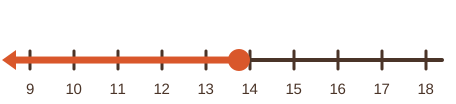
"Subtract 350 from both sides. 120n ≤ 1650. Divide by 120. n ≤ 13.75."
"Brackets come whole," Wren says. "What do you notice? Thirteen brackets fit. Fourteen is too heavy."
"An inequality gives a whole range of answers," Comet says. "And the build picks the one that makes sense."
An inequality is a limit
An inequality uses <, >, ≤ or ≥ instead of an equals sign. Its solutions are usually a whole range of numbers.
The mass rule: 120n + 350 ≤ 2000, in grams. Solve it with the same moves as an equation.
Subtract 350 from both sides, then divide by 120. The result is n ≤ 13.75.
Brackets come in whole numbers, so the most the crew can add is 13. Check: 120 × 13 + 350 = 1,910 grams.
One sign to watch
Adding, subtracting, or multiplying and dividing by a positive number keeps the inequality sign as it is.
Multiplying or dividing both sides by a negative number flips the sign. 3 < 5, but -3 > -5.
The time rule: 30 - 2x > 12, minutes left in a slot after x two-minute runs. Subtract 30: -2x > -18. Divide by -2 and flip: x < 9.
The crew's Loft limits
Here are three limits the crew wrote for the fair. Every number is their own, made up for the story.
| Limit in words | Inequality | Solution | Whole numbers that fit |
|---|---|---|---|
| Plate plus brackets at most 2000 grams | 120n + 350 ≤ 2000 | n ≤ 13.75 | 0 to 13 |
| Fins plus nose at least 40 grams | 6f + 10 ≥ 40 | f ≥ 5 | 5 or more |
| More than 12 minutes left after the runs | 30 - 2x > 12 | ? | ? |
- Read the question.
- Tap your answer.
- Read the question.
- Tap your answer.
| Statement | True or false? |
|---|---|
| n = 13 satisfies 120n + 350 ≤ 2000. | ? |
| n = 14 satisfies 120n + 350 ≤ 2000. | ? |
| f = 5 satisfies 6f + 10 ≥ 40. | ? |
| Dividing both sides of an inequality by -2 flips the sign. | ? |
| An inequality has exactly one solution, like an equation. | ? |
Sharp limit-reading. Tomorrow you rearrange whole formulas for the letter you need, then review the week.