Wednesday
Wednesday: Loft Lab, Measure and Time a Ramp
"Lab day," Comet says, taping a start line across the plank. "Our engineer measures a ramp at home today."
Wren lines up the tape measure along the plank. "Start line to finish line, in centimeters. Then a stopwatch."
"And the cart?" Comet asks. "Not everyone has a wooden cart."
"A toy car, a marble, a rolled-up sock," Wren says. "Anything that rolls or slides."
Nova hovers at the finish line, her light blinking like a stopwatch. "Would you like a hint? Time three runs, not one."
"Three runs, three times," Comet says. "Then speed for each, in centimeters per second."
"And report only the digits the tools can give," Wren adds. "What do you notice when the runs disagree?"
What you need
- A board, stiff cardboard or a long book for a ramp, resting on a box or a step.
- Something that rolls: a toy car, a marble or a ball.
- A tape measure or ruler marked in centimeters, and masking tape for a start and a finish line.
- A stopwatch or a phone timer that shows tenths of a second.
- Your Loft Log and a pencil.
Keep the rolling object away from stairs and from anyone walking by.
Tape the ramp so it cannot slide, and clear the landing area before each run.
Ask a grown-up before using anything heavy or anything with a sharp edge.
Run the lab
- Set the ramp on a box or step. Tape a start line near the top and a finish line near the bottom.
- Measure from the start line to the finish line in centimeters. Write it with the unit.
- Release the rolling object at the start line. Start the timer as it leaves the line.
- Stop the timer when it reaches the finish line. Write the time in seconds, to tenths.
- Repeat for three runs. Compute each speed: distance ÷ time, in centimeters per second.
- Round each speed to the nearest whole number, then change your distance to meters too.
The crew's lab table
Here are the crew's Tuesday runs on the Loft plank. These are their own timings, made up for the story.
| Run | Distance (centimeters) | Time (seconds) | Speed (centimeters per second) |
|---|---|---|---|
| 1 | 240 | 1.6 | 150 |
| 2 | 240 | 2 | 120 |
| 3 | 240 | 1.5 | ? |
| 4 | 240 | 1.7 | ? |
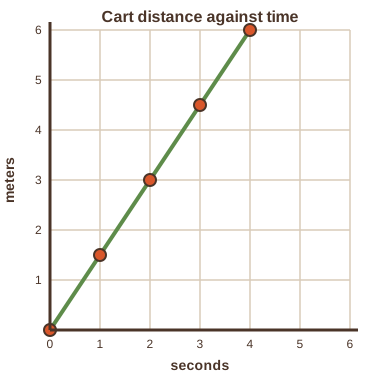
Nova's graph shows a cart at a steady 1.5 meters per second. Seconds run across, meters run up, and the line starts at the origin.
Reading a graph starts with its units and its scale. One square across is one second here, and one square up is one meter.
- Read the question.
- Tap your answer.
| Statement | True or false? |
|---|---|
| Three timed runs tell you more than one run does. | ? |
| A stopwatch that shows tenths can honestly report 1.63 seconds. | ? |
| 240 ÷ 1.6 = 150 | ? |
| 240 centimeters is the same distance as 2.4 meters. | ? |
| Speed in centimeters per second is distance multiplied by time. | ? |
Keep the landing area clear and stop the object with your hand, not your foot.
Great lab work. Tomorrow the crew reads the jug and the frame as expressions, term by term.