Monday
Monday: The Ground Pushes Back
Rocket crouches on the lawn at the Field, then springs straight up. He lands with a thump.
"I pushed the ground," he says, "and I went up. Who pushed me?"
Raven kneels and presses her palm flat on the grass. "What do you notice? The ground does not move, but my hand feels pushed."
Nova drifts down until her glow lights the pressed grass. "Every push is part of a pair," she says. "Find the partner."
Rocket jumps again, slower this time. "My feet push down. Something pushes up. The ground pushes me!"
"Then the ground is in the game too," Raven says, writing in the Field Log.
Nova hums. "A scientist wrote that rule down more than three hundred years ago. Today you learn it."
Forces come in pairs
Sir Isaac Newton presented three laws of motion in 1686. You met the first two in weeks 2 and 3.
The third law is about pairs. Whenever one object exerts a force on another object, the second object exerts an equal and opposite force on the first.
Scientists at NASA say it this way: for every action force in nature there is an equal and opposite reaction. Forces result from interactions.
A physics text puts it plainly. Forces always occur in pairs, and one body cannot exert a force on another without experiencing a force itself.
When Rocket jumps, his feet push down on the ground. The ground pushes up on his feet with the same strength. That upward push lifts him.
| Action force | Reaction force |
|---|---|
| Feet push down on the ground | Ground pushes up on the feet |
| Hand presses on the grass | Grass presses back on the hand |
| A swimmer pushes the pool wall | The wall pushes the swimmer away |
- Read the question.
- Tap your answer.
Why the pair does not cancel
You might think two equal and opposite forces would cancel. They do not, because they act on different objects.
The push on the ground acts on the ground. The push on Rocket acts on Rocket. Only the force on Rocket changes how Rocket moves.
A physics text uses a swimmer to show it. She pushes against the pool wall with her feet and speeds up away from the wall.
The wall exerted an equal and opposite force back on the swimmer. She pushes in the direction opposite to the way she wants to go.
| Statement | True or false? |
|---|---|
| Forces always occur in pairs. | ? |
| The two forces in a pair act on the same object. | ? |
| The reaction force is weaker than the action force. | ? |
| Forces result from interactions between objects. | ? |
Push a little harder. Does the push on your hand grow too? Write "wall push" in your Field Log.
Never push on a window or a door that could swing. Pick a solid wall.
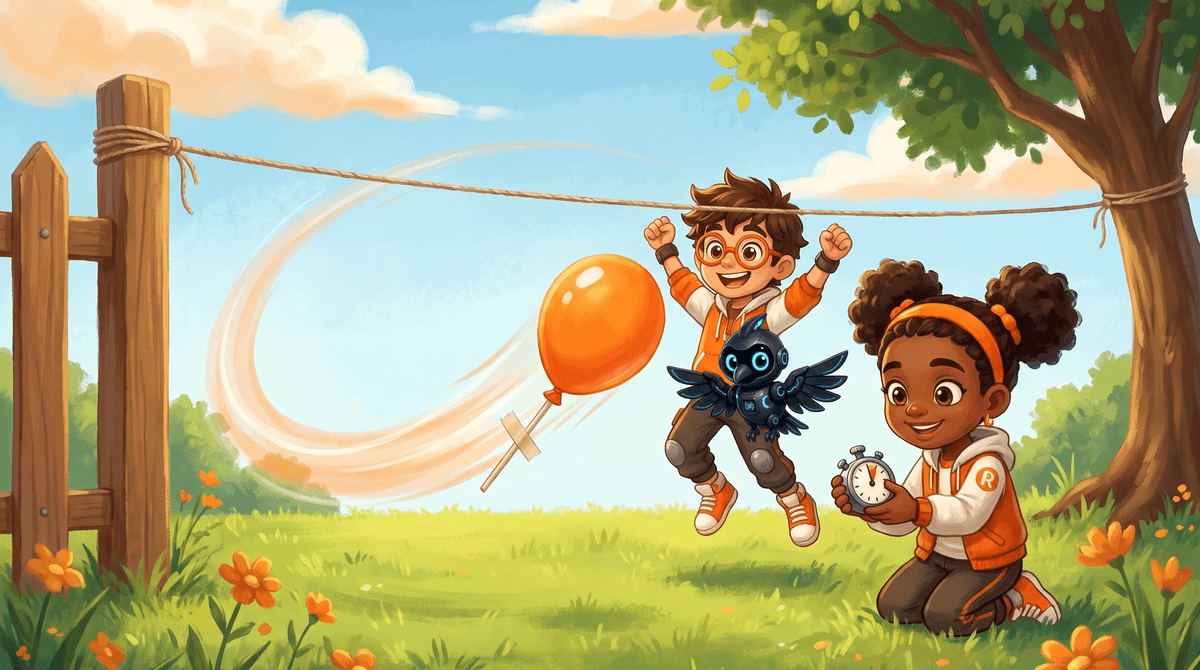
Only soft, light objects are used. Nothing is thrown at a person, and the balloon work happens away from younger children.
The force facts this week come from NASA Glenn Research Center's Beginner's Guide to Aeronautics and a college physics text at libretexts.org.
Strong start. Tomorrow you will see how rockets, cars and even your own walking depend on the push back.