Monday
Monday: Why Does the Ball Stop?
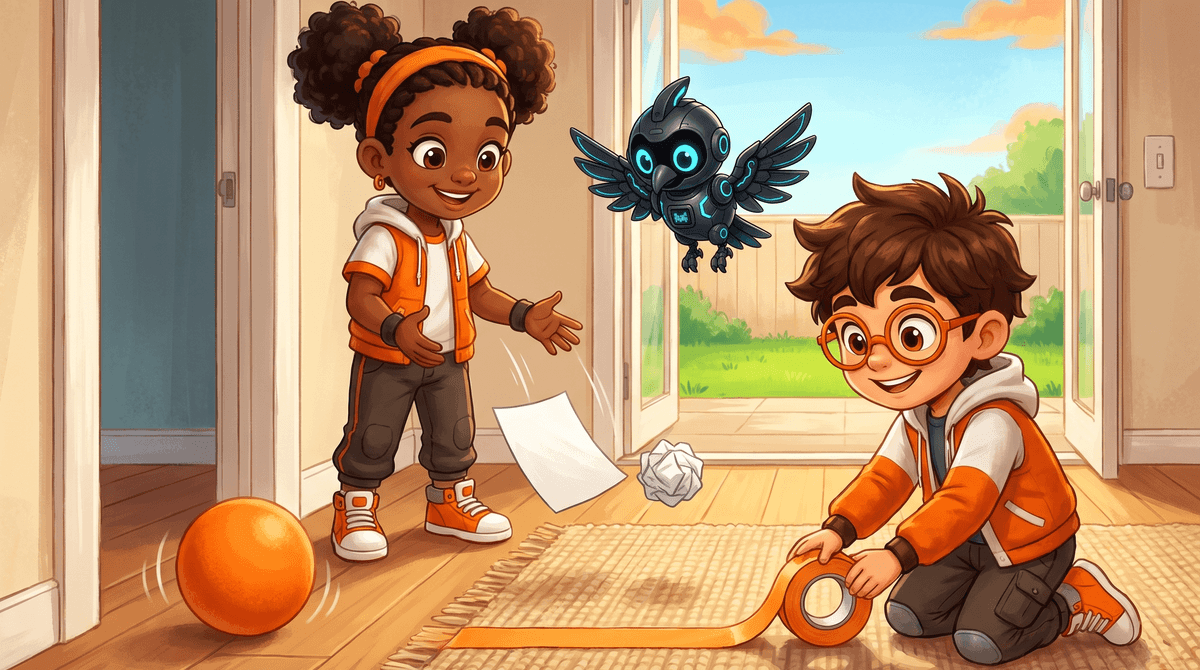
Rocket gives a foam ball one push down the hallway at the Field. It rolls across the wood floor, reaches the rug and slows to a stop.
"Nobody touched it," he says. "No wall, no hand. So what stopped it?"
Raven kneels at the edge of the rug. "What do you notice? It rolled fast on the wood and slow on the rug."
Nova hovers low, her light sliding over the fuzzy rug. "Last week you learned that motion changes only when a force is unbalanced," she says.
Rocket thinks. "So a force acted on it. Something pushed back against the rolling."
"Then the rug is pushing," Raven says. She drops a flat sheet of paper and a crumpled one. The crumpled ball lands first.
"And the air pushes too," Rocket says. Nova hums. "Two hidden forces. Both have names."
Friction: the force that opposes sliding
Friction is a force that opposes motion between systems in contact. Two surfaces touch, and friction pushes against any sliding between them.
Friction acts along the surface where the two objects meet. It always points against the motion, or against the attempted motion.
Friction is around us all the time. It slows a sliding hockey puck on ice, and it also lets you walk without slipping.
A rolling ball touches the floor too. The ball slows down, so an unbalanced force is acting on it. That force is friction between the ball and the floor.
Rough surfaces like carpet and grass push back more than a smooth floor does. The ball stops sooner.
| Word | What it means | Field example |
|---|---|---|
| Friction | A force that opposes motion between touching surfaces | The rug slowing the rolling ball |
| Static friction | Friction that holds a resting object still | A ball sitting still on a gentle slope |
| Kinetic friction | Friction on an object already sliding | A sock sliding across the floor |
| Drag | The push of air or water against something moving through it | The flat paper drifting down slowly |
- Read the question.
- Tap your answer.
Static and kinetic friction
When two touching objects are not moving, static friction can act between them. Static friction holds things still.
When two touching objects slide past each other, the friction between them is called kinetic friction.
Imagine pushing a heavy crate across a concrete floor. You push harder and harder, and it does not move at all.
Static friction responds to your push. It grows to match you, up to a limit. Then the crate suddenly slips and starts to move.
Once the crate is moving, it is easier to keep moving than it was to get started. Kinetic friction is less than static friction.
Add a box on top of the crate, and you must push harder to start it and to keep it going. Oil the floor, and both get easier.
| Statement | True or false? |
|---|---|
| Friction opposes motion between surfaces that touch. | ? |
| Static friction is usually greater than kinetic friction. | ? |
| A heavier crate is easier to slide than a lighter one. | ? |
| Oiling a floor makes a crate harder to push. | ? |
Notice the moment it slips. Was it easier to keep it sliding than to get it going?
Write "static" and "kinetic" in your Field Log and describe what each felt like.
Nothing is thrown, and drops happen from standing height only. A hallway, patio or lawn works as the Field.
The friction and drag facts come from an OpenStax college physics text hosted by LibreTexts. Others come from the NASA Glenn Beginner's Guide to Aeronautics.
Strong start. Tomorrow you will meet drag, the force of the air, and find out why a falling skydiver stops speeding up.