Monday
Monday: What Goes Up Comes Down
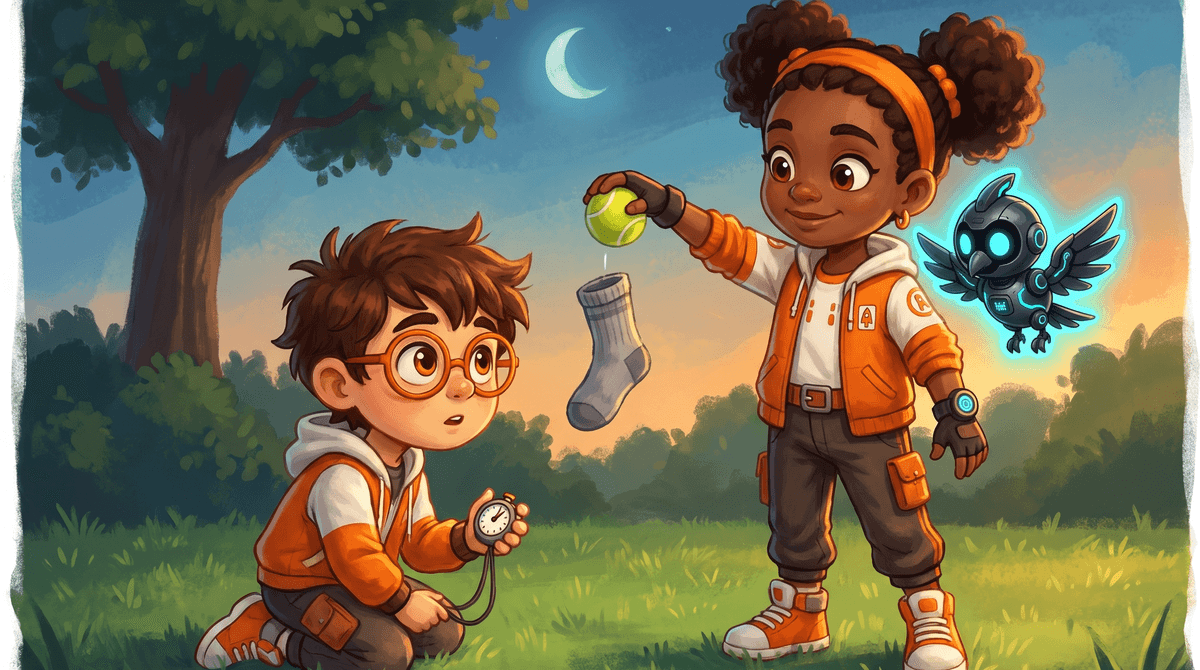
Rocket tosses a rolled sock straight up over the lawn. It rises, slows, stops for an instant, and drops into his hand.
"Every time," he says. "Up, pause, down. I have never once lost a sock to the sky."
Raven catches the next one. "What do you notice at the very top?"
"It stops. Then it comes back faster and faster," Rocket says.
Nova hovers between them, her light steady. "Something pulls on that sock the whole way up and the whole way down. What?"
"Gravity," Rocket says. "But what is gravity pulling it toward?"
Raven points at the grass. "Not the grass. The whole Earth. Every bit of it."
Gravity is a pull toward the center
NASA Space Place defines gravity as the force by which a planet or other body draws objects toward its center.
It is an invisible force that pulls objects toward each other. Earth's gravity keeps you on the ground and makes things fall.
The Next Generation Science Standards add that gravitational forces are always attractive. Gravity only pulls. It never pushes.
Earth's gravity comes from all its mass. NASA says that pull on the mass in your body is what gives you weight.
A tossed sock rises because a hand pushed it. Gravity pulls it the whole time, so it slows, stops and falls.
| Moment in the toss | Which way the sock moves | Which way gravity pulls |
|---|---|---|
| Just after the toss | up | down, toward Earth's center |
| At the very top | stopped for an instant | down, toward Earth's center |
| On the way down | down, faster and faster | down, toward Earth's center |
- Read the question.
- Tap your answer.
Mass makes gravity
NASA Space Place says anything that has mass also has gravity. Objects with more mass have more gravity.
There is a gravitational force between any two masses, the standards note. It is very small unless at least one object has a large mass.
You and a tennis ball pull on each other, but far too weakly to feel. Earth pulls on both of you strongly.
NASA adds that you exert the same gravitational force on Earth that it does on you. Earth is so massive that your pull barely moves it.
| Statement | True or false? |
|---|---|
| Gravity pulls objects toward Earth's center. | ? |
| Gravity pushes a tossed sock upward at the top of its flight. | ? |
| Anything that has mass also has gravity. | ? |
| The gravity between two tennis balls is strong enough to feel. | ? |
Watch for the instant it stops at the top. Describe in your Field Log what the sock does right after.
Nothing is dropped from a chair, ladder or railing. Only a tennis ball, foam ball or rolled sock is used, outdoors or in a cleared hallway.
The gravity facts come from NASA Space Place, the NASA Planetary Fact Sheet and a university physics text, at nasa.gov.
Strong start. Tomorrow you will learn how a falling ball speeds up, and what happened to a hammer and a feather on the Moon.