Monday
Monday: The Hook and the Setup
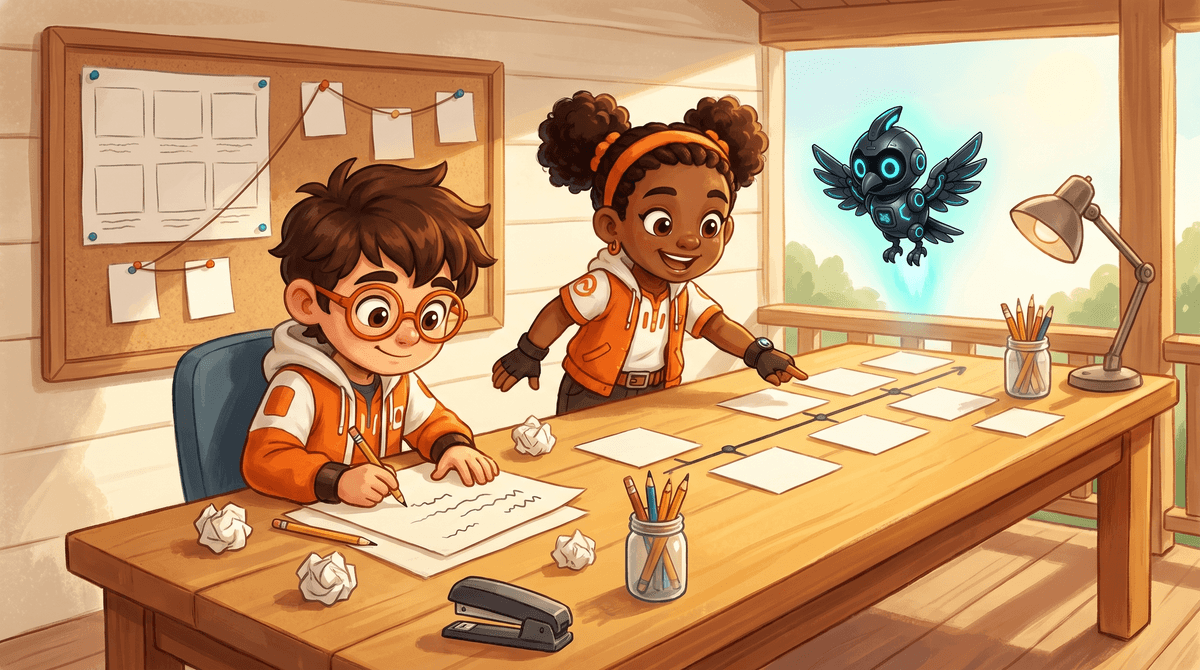
Crumpled paper surrounds Rocket like snow. He is on his sixth first sentence.
"Once there was a boy who had a desk," he reads. He crumples it. "Boring. Nobody keeps reading that."
Raven unrolls a strip of paper and draws six boxes. "Storyboard. Before the first sentence, know the whole shape."
"But the first sentence is the hard part," Rocket says.
Nova hovers over a row of index cards laid out like a timeline. "What is the most surprising moment in your story?" she asks.
Rocket points at card four. "The corkboard falls off the wall."
"Then start near it," Raven says. "Make the reader need to know why."
Rocket writes: The corkboard had never fallen before. He does not crumple it.
Learn it: what an opening has to do
A narrative is a story about real or imagined events. Its opening has two jobs.
The hook makes the reader need to keep going. The setup tells who is here, where we are, when it is, and who is telling.
Raven thinks aloud: "The first line says the corkboard had never fallen before. So I need to know why it fell today."
A good hook is often a surprise, a line of dialogue, a strange detail or an action already in motion.
- Start near the most surprising moment, not at the beginning of the day.
- Name the narrator and the place within the first few lines.
- Give one detail the reader cannot explain yet.
- Keep the first sentence short.
| Kind of hook | Example |
|---|---|
| Surprise | The corkboard had never fallen before. |
| Dialogue | "Nobody is hurt," Nova said first. |
| Strange detail | Rocket stood in the middle of sixty cards, holding one pin. |
| Action in motion | I heard the crash from the bottom step. |
- Read the question.
- Tap your answer.
Read it: the mentor text
The corkboard had never fallen before.
For a whole year it had hung above the Signal Desk and held every card we pinned to it. Through wind, rain and Rocket.
So when I came up the porch steps that Thursday and heard a sound like a door slamming flat, I knew.
Nova was hovering in the doorway with her light turned up to full.
"Nobody is hurt," she said first, which is the thing she always says first. "But you should see this."
The board lay face down on the table. Cards had scattered to every corner of the porch like startled leaves.
Rocket stood in the middle of them, holding one pin, looking at the empty wall.
"I only moved one card," he said.
- Read the question.
- Tap your answer.
| Sentence | True or false? |
|---|---|
| The story is told in first person. | ? |
| The board fell onto the floor. | ? |
| Nova always says nobody is hurt first. | ? |
| The opening begins with the narrator waking up. | ? |
- Read the question.
- Tap your answer.
Then try a new first line that starts near the surprise.
Write it: plan your story
My first sentence is short and starts near that moment.
The first few lines name my narrator and the place.
I left one detail the reader cannot explain yet.
A hook is a question the reader cannot help asking. Tomorrow we move through the middle without losing anyone.