Monday
Monday: How a Scene Fits
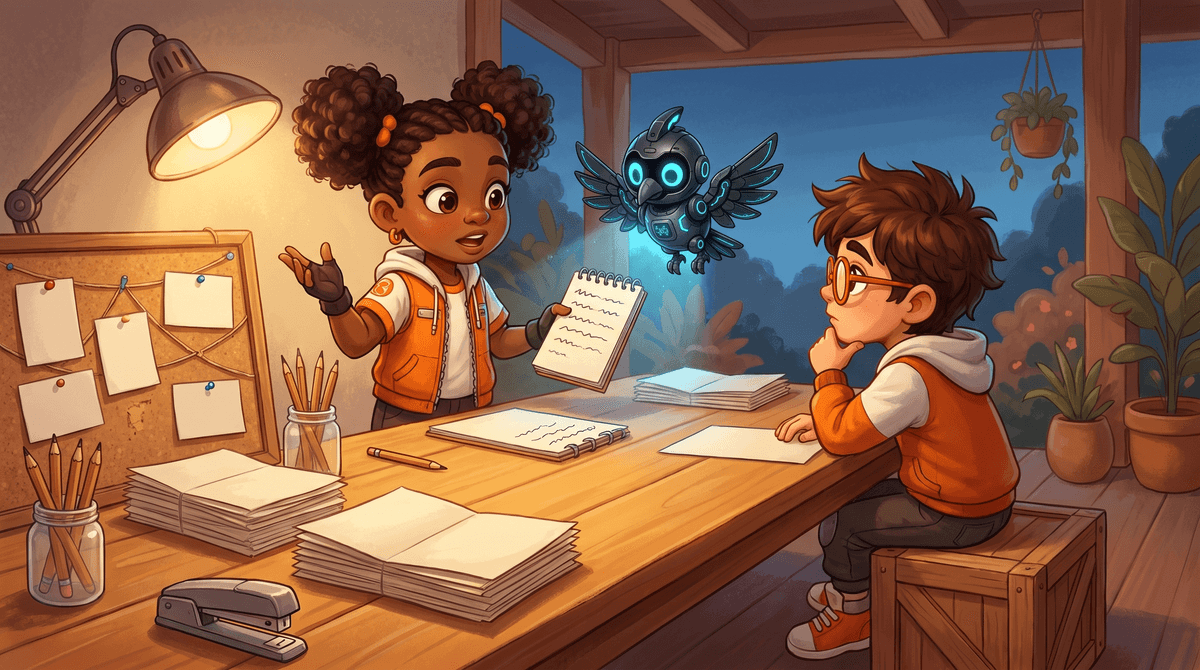
Dusk settles over the porch, and Raven switches on the reading lamp at the Signal Desk.
"Listen to this," she says, and reads a page of her story aloud. Rocket listens with his chin on his fists.
"Wait," he says when she stops. "The part about the corkboard. Why is it there? Nothing happens."
"What do you notice right after it?" Raven asks.
Rocket thinks. "After it, everybody goes outside. So that scene is the push."
Nova hovers at the edge of the lamplight. "A story is a row of rooms," she says. "Every room has a door into the next."
"So no room is just a room," Rocket says. Raven smiles. "Now you are reading like a builder."
Learn it: every scene has a job
Structure is how a story is built. A scene is one stretch of action in one place and time.
Each scene does a job for the whole: it introduces a problem, adds a clue, builds the tension, or resolves things.
Raven thinks aloud: "The text spends a whole scene on the pinholes, so I can infer that the missing card matters later."
To test a scene, imagine cutting it. If the story stops making sense, the scene had a job.
- Name where and when the scene happens.
- Say what changes by the end of the scene.
- Ask what the next scene needs from this one.
- Imagine cutting it. What breaks?
| Scene job | What it does | Signal word |
|---|---|---|
| Introduce | sets up the people and the problem | the opening |
| Build | adds a clue or builds the tension | the middle |
| Turn | changes the direction of the search | the push |
| Resolve | answers the problem | the ending |
- Read the question.
- Tap your answer.
Read it
Scene one. Tuesday night, the Signal Desk. Rocket laid the pages of the new issue in a row. One, two, four.
"Where is three?" he asked. Raven lifted every stack on the table. Page three was gone.
Scene two. The corkboard. Raven stood in front of the pinned cards and read each one slowly.
The card for page three said: Garden report, Raven. Below it, a second card had been pinned and then removed. Four pinholes remained.
"Someone pinned a note here and took it back," she said. "What do you notice about the holes?" "They are fresh," Rocket said.
Scene three. The porch steps, an hour later. Nova drifted along the railing with her light turned low.
"I am not going to tell you where it is," she said. "But paper is light, and the porch door was open all afternoon."
Rocket looked at the maple tree. Raven looked at the gap under the steps. They both got up at once.
Scene four. Under the steps, in the dry leaves, page three lay face down with a small muddy pawprint on one corner.
Scout sat beside it, pleased with himself. The second card, the one with four pinholes, was stuck to his collar.
It read, in Rocket's handwriting: Reminder, close the porch door.
Raven laughed until she had to sit down. Rocket pinned the reminder back on the board, very firmly, and closed the door.
- Read the question.
- Tap your answer.
- Put the scenes in order.
- Tap the cards in order.
| Sentence | True or false? |
|---|---|
| The missing page was the garden report. | ? |
| Nova told the crew exactly where the page was. | ? |
| The reminder card was in Rocket's handwriting. | ? |
| The story ends with the porch door still open. | ? |
- Read the question.
- Tap your answer.
Pull one note out. Say out loud what breaks without it.
Every room has a door into the next. Tomorrow we meet the voice that walks us through the rooms.