Thursday
Thursday: The Field Day Map
Raven tapes two long strips of paper into a cross on the kitchen floor. "The Field Day map. The Numbers Desk is the center, (0, 0)."
"Right and up are positive," Rocket says. "Left and down are negative. Like two number lines."
"Ring Toss is 3 right and 2 up," Raven reads from her log. "That is (3, 2). What do you notice about the Hop Course?"
"Four left, two up. (-4, 2)." Rocket plants a counter. "Same height, other side."
Nova hovers above the cross. "Those two are 7 units apart," she says. "Count from one to the center, then out again."
"Four and three," Rocket says. "The absolute values, added."
Nova hums. "Now place the Scoop Station, and tell me which quadrant it lands in."
Four quadrants
A coordinate plane is two number lines crossed at 0. The horizontal one is the x-axis, the vertical one is the y-axis.
A point is named (x, y): across first, then up or down. (3, 2) is 3 right and 2 up. (-4, 2) is 4 left and 2 up.
The axes split the plane into four quadrants, numbered I, II, III and IV going counterclockwise from the upper right.
| Quadrant | x sign | y sign | Example |
|---|---|---|---|
| I | positive | positive | (3, 2) |
| II | negative | positive | (-4, 2) |
| III | negative | negative | (-3, -3) |
| IV | positive | negative | (3, -3) |
The crew's map
| Station | x | y | Point |
|---|---|---|---|
| Ring Toss | 3 | 2 | (3, 2) |
| Hop Course | -4 | 2 | (-4, 2) |
| Scoop Station | -3 | -3 | (-3, -3) |
| Finish Line | 3 | -3 | (3, -3) |
| Sign Tent | 1 | 4 | (1, 4) |
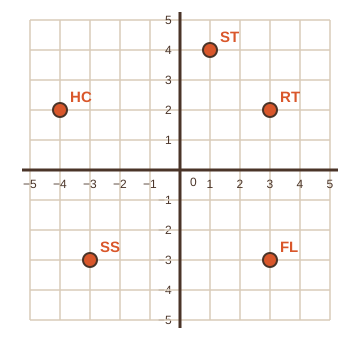
Ring Toss (3, 2) and Hop Course (-4, 2) share a y-coordinate, so they sit on one horizontal line.
Their distance is |3| + |-4| = 7 units, because 0 is between them.
Mirror images: flipping the sign of x reflects a point across the y-axis. (3, 2) and (-3, 2) are reflections.
Flipping the sign of y reflects across the x-axis. (3, 2) and (3, -2) are reflections too.
- Read the question.
- Tap your answer.
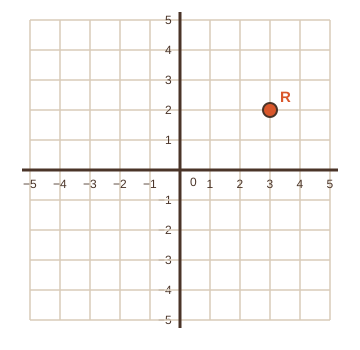 Point R is at (3, 2). Which quadrant is it in?
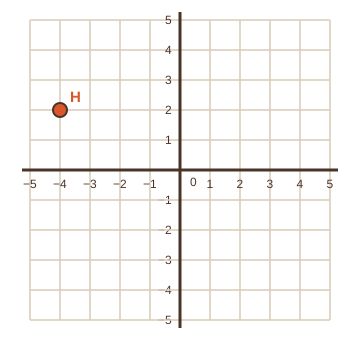 Point H is at (-4, 2). Which quadrant is it in?
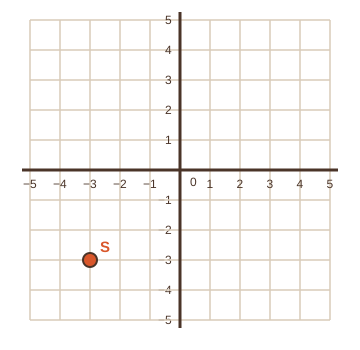 Point S is at (-3, -3). Which quadrant is it in?
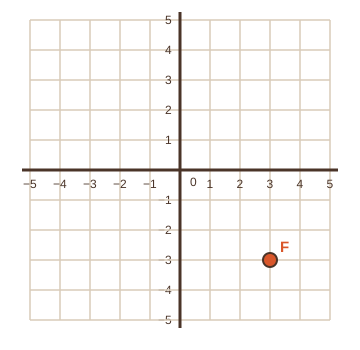 Point F is at (3, -3). Which quadrant is it in?
- Read the question.
- Tap your answer.
- Read the question.
- Tap your answer.
Place an object at (2, -1) and another at (-2, -1). Count the units between them.
Map drawn. Tomorrow you find signed numbers in everyday life and review the whole week.