Monday
Monday: A Rate Per 100
Rocket slaps the sign-up sheet onto the Numbers Desk. "Forty kids signed up for Field Day. Ten picked the relay."
"Ten is a lot," he says. "Almost everybody wants the relay."
"What do you notice when you compare 10 to 40?" Raven asks.
Rocket counts on the sheet. "Ten out of forty. That is 1 out of every 4. One fourth."
Nova hovers over the sheet, her light making a small circle. "Imagine 100 kids signed up instead. How many would pick the relay?"
"Twenty-five," Rocket says slowly. "Twenty-five out of 100."
Raven writes 25% beside the relay. "That is a percent. Per 100. Now we can compare every game."
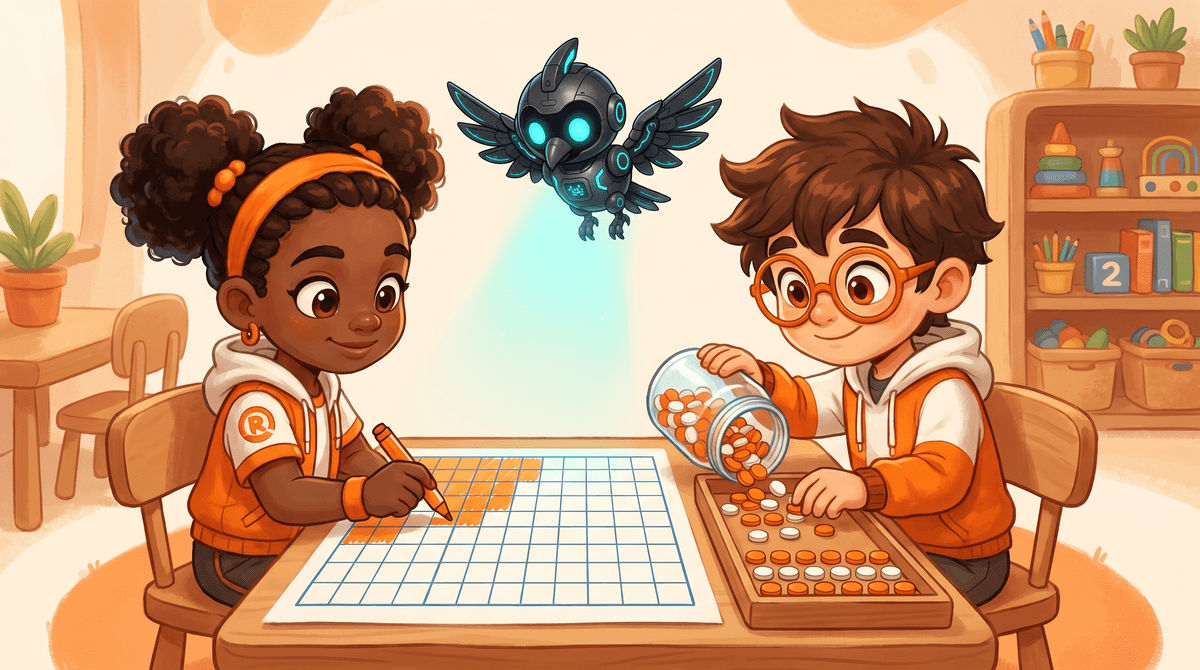
Percent means per 100
A percent is a rate per 100. The sign % means out of 100, so 25% means 25 out of every 100.
A hundred grid shows a percent as a picture. Shade 25 of the 100 squares and you have 25%.
The relay got 10 of 40 sign-ups. Scale the ratio 10:40 up to 25:100, and the percent is 25%.
Percents, fractions and decimals say the same thing. 25% = 25/100 = 1/4 = 0.25.
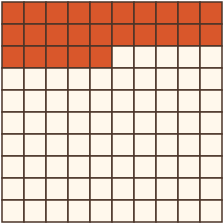
Worked example: a percent of a number
Thirty percent of the 40 kids want a water break halfway. How many kids is that?
30% means 30/100. So 30% of 40 is 30/100 × 40 = 1200/100 = 12 kids.
Another way: 10% of 40 is 4, because 40 ÷ 10 = 4. Then 30% is three tens, 3 × 4 = 12.
- 25% of the sign-ups chose the relay: 25 out of every 100.
- 50% is one half. 10% is one tenth. 100% is the whole thing.
- A percent over 100 means more than the whole, like a batch that is 200% of the recipe.
- Read the question.
- Tap your answer.
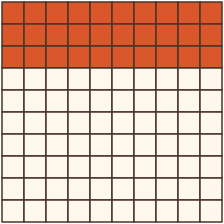 What percent of the grid is shaded?
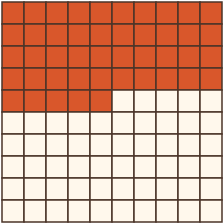 What percent of the grid is shaded?
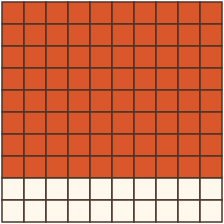 What percent of the grid is shaded?
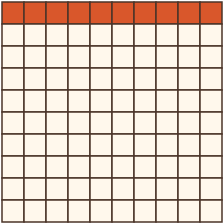 What percent of the grid is shaded?
- Read the question.
- Tap your answer.
- Read the question.
- Tap your answer.
Lay them in two rows of 10. What fraction is the different color? Scale it to 100 to find the percent.
Try 10 different counters out of 20, then 2 out of 20. Say each as a percent.
Nothing from the Numbers Desk goes in anyone's mouth.
Clear thinking. Tomorrow you learn the method for percents of numbers and finding the whole.