Thursday
Thursday: The Timing Log
Raven spreads the Field Day timing log across the Numbers Desk. Four runners, four distances, four times.
"Helper 1 ran 56 meters," Rocket says. "Longest run. Helper 1 is fastest."
"What do you notice about the seconds column?" Raven asks.
"They are all different," Rocket says. "Oh. Different distances and different times. I need unit rates."
Nova dims her light to a soft glow. "Four divisions. Then the ranking will be fair."
Rocket works down the table. "Rocket 5. Raven 6. Helper 1 is 7. Helper 2 is 4."
"Helper 1 is still fastest," he says, "but now I can prove it."
Read the log
These times are the crew's own made-up Field Day log. Each runner ran a different distance, so the raw numbers cannot be compared.
Divide meters by seconds for each runner. The unit rates can be compared, because every one is for exactly 1 second.
Rocket fell for a trap. A longer run is not a faster run, and a shorter time is not a faster run either.
Only the unit rate tells you about speed. Once you have it, the ranking is just putting four numbers in order.
| Runner | Meters | Seconds | Meters per second |
|---|---|---|---|
| Rocket | 40 | 8 | 5 |
| Raven | 30 | 5 | 6 |
| Helper 1 | 56 | 8 | 7 |
| Helper 2 | 36 | 9 | 4 |
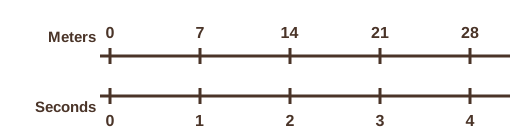
The double number line shows Helper 1's rate. Every second adds 7 meters, so 8 seconds reach 56 meters.
- Read the question.
- Tap your answer.
- ?Helper 1, 7 meters per second
- ?Raven, 6 meters per second
- ?Rocket, 5 meters per second
- ?Helper 2, 4 meters per second
- Read the question.
- Tap your answer.
Predict how long 5 pages would take. Then try it and compare.
Fair ranking. Tomorrow you find rates all around you and review the week.