Monday
Monday: A Table With a Name
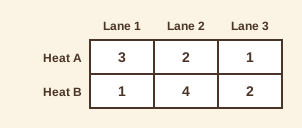
The corkboard in the shed is a grid of lane cards. Heats down the side, lanes across the top.
"Every card has a tally," Wren says. "Morning practice runs. Heat A, lane 1, three runs."
"Six cards, six numbers," Comet says. "What can we make of a grid like that?"
"Give it a name," Wren says, writing M beside the board. "Then the whole grid is one object."
Nova projects the six numbers in square brackets. "Would you like a hint? Rows first, then columns."
"Two rows, three columns," Comet reads. "A 2 by 3 matrix."
"The afternoon tally is another one, the same size," Wren says. "Add them card by card and we have the day."
"And double every card for the two-week plan," Comet says. "That is one number times the whole grid."

What a matrix is
A matrix is a rectangular table of numbers. Each number is an entry, and each entry has a row and a column.
The morning tally is M = [3 2 1; 1 4 2]. Rows are separated by semicolons: the first row is 3, 2, 1.
M has 2 rows and 3 columns, so it is a 2 by 3 matrix. Rows first, then columns, always.
The entry in row 2, column 2 is 4: Heat B ran lane 2 4 times.
Adding matrices and scaling them
Two matrices of the same size add entry by entry: row 1 column 1 with row 1 column 1, and so on.
Afternoon tally N = [2 1 3; 0 2 1]. The day's total is M + N = [5 3 4; 1 6 3].
A scalar multiplies every entry. Doubling the morning plan for two weeks gives 2M.
2M = [6 4 2; 2 8 4]. Every card doubled, nothing else changed.
Matrices of different sizes cannot be added. A 2 by 3 and a 3 by 2 have no matching entries.
A solved problem to study
- The crew wants the day's total for Heat A, lane 3. M has 1 there and N has 3.
- Add the matching entries: 1 + 3 = 4.
- Do the same for all six positions: M + N = [5 3 4; 1 6 3].
- Now the two-week plan: multiply each entry of M by 2. Row 1 becomes 6, 4, 2.
- So 2M = [6 4 2; 2 8 4]. The size stays 2 by 3, because scaling moves no entries.
- Check one entry back: row 2, column 1 of 2M should be twice row 2, column 1 of M. It is.
| Matrix | Meaning | Row 1 | Row 2 |
|---|---|---|---|
| M | morning runs | 3 2 1 | 1 4 2 |
| N | afternoon runs | 2 1 3 | 0 2 1 |
| M + N | the day's runs | 5 3 4 | 1 6 3 |
| 2M | two weeks of mornings | 6 4 2 | 2 8 4 |
- Read the question.
- Tap your answer.
| Statement | True or false? |
|---|---|
| M = [3 2 1; 1 4 2] is a 2 by 3 matrix. | ? |
| A 2 by 3 matrix can be added to a 3 by 2 matrix. | ? |
| 1 + 3 = 4 | ? |
| Multiplying a matrix by 2 doubles only the first row. | ? |
| 2 × 4 = 8 | ? |
Write a second tally the same size and add them. Then double the first one.
Strong start. Tomorrow a row meets a column, and matrix multiplication turns runs into laps.