Friday
Friday: Matrices Everywhere
Friday the crew clears the corkboard and lists every grid they have met this week.
"The lane tallies," Comet says. "Runs by boat and course. Laps and turns per run."
"The hull's corners," Wren adds. "And the stretch, the flip, the shear. Every one a matrix."
Nova projects a map of the three docks with arrows between them. "Would you like a hint? A grid can hold a network."
"Row for the dock you leave, column for the dock you reach," Wren says. "A 1 if a path exists, a 0 if not."
"So a matrix holds counts, moves and connections," Comet says. "What do you notice they share?"
"Rows and columns with meanings," Wren says. "Keep the labels and the arithmetic stays honest."
"Then one more time through everything," Comet says, "and the log is complete."
Where matrices show up
- Tables of counts: tallies by heat and lane, runs by boat and course. Add days, scale plans.
- Rates per item: laps and turns per run. Multiply counts by rates to get totals, labels matching in the middle.
- Transformations: a 2 by 2 matrix stretches, flips, shears or turns every point of a drawing.
- Networks: a 1 where two docks are joined by a path and a 0 where they are not. The grid is the map.
- Systems of equations: two unknowns, two equations, one matrix sentence solved with an inverse.
A dock network
Three docks: the shed dock, the far post and the buoy raft. A path runs shed to post, post to raft and shed to raft.
Rows are where you leave, columns are where you arrive. Each path goes both ways, so the matrix is symmetric.
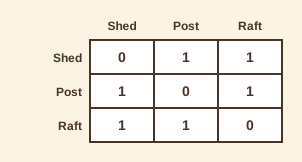
Each row adds to 2: every dock is joined to two others. The matrix holds the whole map, and no picture is needed to read it.
Mixed review
- Read the question.
- Tap your answer.
![A blue shape with vertices (0, 0), (3, 2) and its red image under [1 0; 0 -1], vertices (0, 0), (3, -2)](/assets/math/transform-1_0-0_n1-0_0-3_2.svg) Apply the flip [1 0; 0 -1] to the point ⟨3, 2⟩. Where does it land?
Apply the flip [1 0; 0 -1] to the point ⟨3, 2⟩. Where does it land?![A blue shape with vertices (0, 0), (1, 0), (1, 1), (0, 1) and its red image under [3 0; 0 2], vertices (0, 0), (3, 0), (3, 2), (0, 2)](/assets/math/transform-3_0-0_2-0_0-1_0-1_1-0_1.svg) The matrix [3 0; 0 2] transforms the hull drawing. By what factor does it multiply every area?
The matrix [3 0; 0 2] transforms the hull drawing. By what factor does it multiply every area?- Read the question.
- Tap your answer.
| Statement | True or false? |
|---|---|
| Matrices of the same size add entry by entry. | ? |
| A scalar multiplies only the diagonal entries. | ? |
| 2 × 1 + 1 × 4 = 6 | ? |
| The determinant's absolute value is the area factor of the transformation. | ? |
| A matrix with determinant 0 has an inverse. | ? |
Add each row. Which place is joined to the most others?
Fine week's work. Tomorrow is Dock Day: the boat cutout goes on the family table.