Wednesday
Wednesday: Boathouse Lab, the Cardboard Gauge
Comet cuts a big circle from cardboard with scissors and pins it to the workbench so it can spin.
"One peg on the rim," she says. "Spin it to an angle, and the peg's height above the center is the sine."
Wren sets the radius at 10 centimeters. "Then a height of 5 centimeters means sin equals one half."
He turns the wheel to 30° and measures. "Five. Now I measure the height first and find the angle. That is the inverse."
Nova projects the gauge post beside the wheel. "Would you like a hint? Your wheel is the gauge post, rolled up."
"Height 5 shows up at 30° and at 150°," Comet says. "Just like the water hitting 4 meters twice a day."
"Record every reading," Wren says. "Then we run the real log through it."
What you need
- Cardboard, scissors, a pin or pushpin, a ruler, a protractor and a pencil. Your Boathouse Log.
- A grown-up pushes the pin through the center and into a cork or a thick cardboard base.
- Graph paper for the wave you will draw from your table.
Cut the cardboard with scissors only, sitting down. The grown-up handles the pin.
Nothing heavy is lifted alone. Keep pins in a lid when not in use and off the floor.
Run the lab
- Draw a circle of radius 10 centimeters on cardboard and cut it out. Mark its center.
- Draw a horizontal line through the center of your base sheet. Pin the circle so it spins over the line.
- Mark one point on the rim and turn it to 0°, 30°, 60°, 90°, and on around to 360°.
- At each angle, measure the height of the mark above the center line in centimeters. Below the line counts as negative.
- Divide each height by 10. That column is sin of your angle. Compare with the exact values you know.
- Now reverse it: pick a height, say 5, and find every angle on your wheel that gives it.
The crew's wheel readings
Here are the crew's own wheel readings, measured to the nearest half centimeter. Yours may differ by a little.
| Angle | Height (cm) | Height ÷ 10 | Exact sine |
|---|---|---|---|
| 0° | 0 | 0 | 0 |
| 30° | 5 | 0.5 | 1/2 |
| 60° | 8.5 | 0.85 | √3/2 |
| 90° | 10 | 1 | 1 |
| 120° | 8.5 | 0.85 | √3/2 |
| 150° | 5 | 0.5 | 1/2 |
| 180° | 0 | 0 | 0 |
| 210° | -5 | -0.5 | -1/2 |
| 240° | -8.5 | -0.85 | -√3/2 |
| 270° | -10 | -1 | -1 |
| 300° | -8.5 | -0.85 | -√3/2 |
| 330° | -5 | -0.5 | -1/2 |
Read the table backwards. Height 5 appears at 30° and 150°. Height -5 appears at 210° and 330°.
The inverse on your wheel gives the angle in the right half, from -90° to 90°. The other comes from the mirror.
Now the gauge post
The crew's log for one cycle, from the dawn reading. The model is h = 1.2 sin(30t) + 3.4, so every hour turns the wheel 30°.
| Hours after dawn (t) | Gauge reading (m) |
|---|---|
| 0 | 3.4 |
| 1 | 4 |
| 2 | 4.44 |
| 3 | 4.6 |
| 4 | 4.44 |
| 5 | 4 |
| 6 | 3.4 |
| 7 | 2.8 |
| 8 | 2.36 |
| 9 | 2.2 |
| 10 | 2.36 |
| 11 | 2.8 |
| 12 | 3.4 |
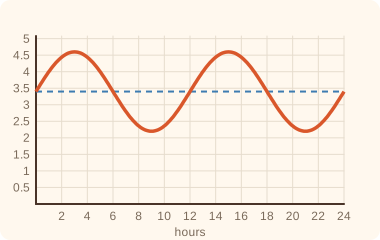
- Read the question.
- Tap your answer.
| What the lab shows | True or false? |
|---|---|
| Each height between -10 and 10 appears at exactly two angles on the wheel in one turn. | ? |
| A height of 12 centimeters is possible on a 10 centimeter wheel. | ? |
| Height ÷ radius is the sine of the angle. | ? |
| In the gauge log, the reading 4.6 appears once per cycle, at the peak. | ? |
| The gauge model turns the wheel 15° every hour. | ? |
Careful lab work. Tomorrow the whole day of readings gets solved, and the gauge wave gets its proof.