Monday
Monday: Which Angle Has That Sine?
Dawn mist sits on the lake. Wren wades to the depth gauge post in his life vest while a grown-up watches from the dock.
"3.4 meters," he calls. "Same as yesterday at this hour. Nova, what does the log say for the whole day?"
Nova projects a wave over the water. "The crew's readings rise to 4.6, fall to 2.2, and repeat every 12 hours."
"A sine wave," Comet says, sketching it. "h = 1.2 sin(30t) + 3.4. So when does the water first reach 4 meters?"
Wren frowns. "That means sin(30t) = 0.5. I know sin 30° is one half. But sin 150° is one half too."
Nova dims. "Would you like a hint? Which half of the wave are you standing on?"
"The rising half," Comet says, circling one point. "Pick that one first. The rest come from symmetry."

Sine gives one number, but a number has many angles
sin 30° = 1/2. So does sin 150°, sin 390° and sin -210°. One output, endless inputs.
A function can only be undone when each output comes from one input. Sine fails that test on its whole domain.
So we restrict sine to -90° to 90°. On that piece it only rises, from -1 up to 1, and never repeats a value.
Restricted sine has an inverse, called arcsin. arcsin(x) is the one angle between -90° and 90° whose sine is x.
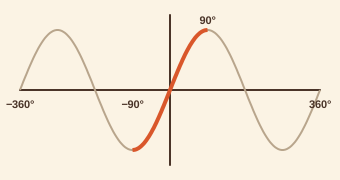
A solved problem to study
- The crew's gauge model: h = 1.2 sin(30t) + 3.4, with t in hours after the dawn reading and 30t in degrees.
- Set h = 4: 1.2 sin(30t) + 3.4 = 4.
- Subtract 3.4: 1.2 sin(30t) = 0.6. Divide by 1.2: sin(30t) = 0.5.
- Take arcsin: 30t = arcsin(0.5) = 30°. This is the principal value.
- Divide by 30: t = 1. The water first reads 4 meters 1 hour after dawn.
- Check: 1.2 × sin 30° + 3.4 = 1.2 × 1/2 + 3.4 = 4. True.
Notice the order: undo the add, undo the multiply, then undo the sine. Each step peels one layer off t.
Every number here is the crew's own reading from Nova's log, not a fact about any real lake.
- Read the question.
- Tap your answer.
| Statement | True or false? |
|---|---|
| sin 30° and sin 150° are equal. | ? |
| Sine on its whole domain has an inverse function. | ? |
| arcsin(1/2) = 30° because 30° is in the range -90° to 90°. | ? |
| 1.2 × 0.5 + 3.4 = 4 | ? |
| arcsin(1/2) could also be 150°. | ? |
Mark where the line crosses the wave. Count the crossings, then shade the piece from -90° to 90°.
Strong start. Tomorrow arccos and arctan get their own ranges, and the unit circle finds every other solution.