Thursday
Thursday: Proof Day, the Formula From a Picture
"The ruler agreed," Wren says, pinning a clean sheet to the wall. "Today we say why."
He draws a line from a point O and marks angle a above it, then angle b above that. "Point P, distance 1 from O."
"So P is at height sin(a + b)," Comet says. "What do you notice if we drop P onto the first tilted line?"
"Call the foot Q," Wren says. "Triangle OQP has hypotenuse 1 and angle b at O. So OQ = cos b and PQ = sin b."
Nova lights two small right triangles, one under Q and one beside P. "Would you like a hint? Both have angle a."
"Q sits at height OQ sin a," Comet says. "And P rises PQ cos a above Q. Add them."
"sin a cos b + cos a sin b," Wren says. "Finish the proof."
The theorem
Take angles a and b between 0° and 90° with a + b under 90°. Then sin(a + b) = sin a cos b + cos a sin b.
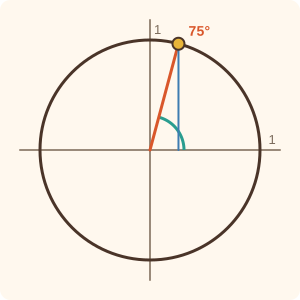
Given: a ray from O along the x-axis. The angle a + b opens from it, and P sits on it at distance 1 from O.
To prove: the height of P above the x-axis is sin a cos b + cos a sin b.
The proof, read first
- P is at distance 1 from O at angle a + b, so its height above the x-axis is sin(a + b).
- Draw the ray at angle a. Drop a perpendicular from P to that ray, landing at Q.
- In right triangle OQP the hypotenuse OP is 1 and the angle at O is b. So OQ = cos b and PQ = sin b.
- Q lies on the ray at angle a, at distance cos b from O. So Q is at height OQ sin a = cos b sin a.
- The segment PQ is perpendicular to the ray, so it makes angle a with the vertical. P rises PQ cos a = sin b cos a above Q.
- Add the two heights: sin(a + b) = sin a cos b + cos a sin b.
Every step uses a fact you already own. A point at distance 1 has height sine (week 5). In a right triangle with hypotenuse 1, the legs are cos and sin.
The same picture gives cosine. Read distances along the x-axis instead of heights. Q sits at cos a cos b, and P sits sin a sin b back from it.
So cos(a + b) = cos a cos b - sin a sin b. The minus appears because PQ leans back toward O.
The unit circle extends both formulas to every angle. The reflection rules from week 5 carry the signs.
Tangent, by division
- Start with tan(a + b) = sin(a + b) / cos(a + b).
- Replace the top by sin a cos b + cos a sin b. Replace the bottom by cos a cos b - sin a sin b.
- Divide every term, top and bottom, by cos a cos b.
- The top becomes tan a + tan b. The bottom becomes 1 - tan a tan b.
- ?Drop a perpendicular from P to the ray at angle a, landing at Q
- ?P is at distance 1 from O at angle a + b, so its height is sin(a + b)
- ?P rises PQ cos a = sin b cos a above Q
- ?Q is at height OQ sin a = cos b sin a
- ?In triangle OQP, OQ = cos b and PQ = sin b
- ?Add the heights: sin(a + b) = sin a cos b + cos a sin b
- Read the question.
- Tap your answer.
| Statement | True or false? |
|---|---|
| In the proof, OQ = cos b because OP = 1. | ? |
| Q is at height sin b above the x-axis. | ? |
| PQ makes angle a with the vertical, so P rises sin b cos a above Q. | ? |
| tan(a + b) comes from dividing sin(a + b) by cos(a + b). | ? |
| The proof only works when a + b is more than 90°. | ? |
Clear reasoning. Tomorrow a = b, and the formulas fold in half.