Tuesday
Tuesday: Around the Circle, Reflections
Wren chalks a big circle on the dock with the mast's base at its center.
"Radius one," he says. "Every point on it is (cos x, sin x) for the angle x from this line."
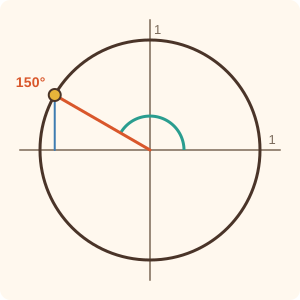
Comet marks 30°, then walks the long way round to 150°. "Same height above the line. What do you notice?"
"150° is 180° minus 30°," Wren says. "Sine stays 1/2. Cosine flips to -√3/2."
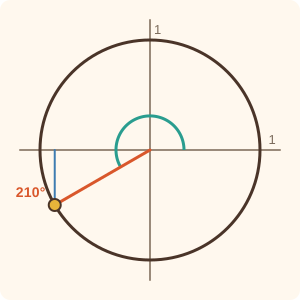
Nova lights a point straight across the circle at 210°. "Would you like a hint? Go through the center."
"Both coordinates flip," Comet says. "Sine -1/2, cosine -√3/2. But tangent is a negative over a negative."
"So tan 210° = tan 30° = √3/3," Wren says. "Three reflections, three rules. Let us write them all."
One point, three reflections
On the unit circle the point for angle x is (cos x, sin x). Reflect it three ways and you reach three new angles.
Across the y-axis: π - x. The height stays, the x-coordinate flips. sin(π - x) = sin x, cos(π - x) = -cos x.
Through the center: π + x. Both coordinates flip. sin(π + x) = -sin x, cos(π + x) = -cos x, and tan(π + x) = tan x.
Across the x-axis: 2π - x. The x-coordinate stays, the height flips. sin(2π - x) = -sin x, cos(2π - x) = cos x.
Way one: the reflection rule
To find cos 150°, write 150° = 180° - 30°. The rule says cos(π - x) = -cos x, so cos 150° = -cos 30° = -√3/2.
To find tan 330°, write 330° = 360° - 30°. The rule says tan(2π - x) = -tan x, so tan 330° = -√3/3.
Way two: reference angle and quadrant
Find the acute angle between the terminal side and the x-axis. That reference angle gives the size of each value.
Then read the sign from the quadrant: sine is positive above the x-axis, cosine is positive to the right of the y-axis.
Tangent is positive when sine and cosine share a sign, in quadrants 1 and 3.
Both ways agree every time. The rule is faster when the angle is written as a reflection. The quadrant check catches sign slips.
| Angle | Radians | sin | cos | tan |
|---|---|---|---|---|
| 30° | π/6 | 1/2 | √3/2 | √3/3 |
| 150° | 5π/6 | 1/2 | -√3/2 | -√3/3 |
| 210° | 7π/6 | -1/2 | -√3/2 | √3/3 |
| 330° | 11π/6 | -1/2 | √3/2 | -√3/3 |
- Read the question.
- Tap your answer.
- Read the question.
- Tap your answer.
What is cos 150°? Write 150° as 180° - 30°.What is sin 210°? Write 210° as 180° + 30°.| Statement | True or false? |
|---|---|
| sin(π - x) = sin x. | ? |
| cos(π + x) = cos x. | ? |
| tan(π + x) = tan x because both coordinates flip and the signs cancel. | ? |
| cos 330° = √3/2. | ? |
| Tangent is positive in quadrant 2. | ? |
| sin 150° = 1/2. | ? |
Check: the four points make a rectangle. Say which coordinate changed at each corner.
Clear work around the circle. Tomorrow is Boathouse Lab: a stick, its shadow and a tape find the angle of the light.