Thursday
Thursday: Even, Odd and the Turn
Wren stands at the center of the chalk circle with a rope to its edge.
"Turn 30° one way," Comet says. He does. "Now 30° the other way. What do you notice?"
"Same distance along the dock," Wren says. "Opposite heights. One up, one down."
"So cos(-30°) = cos 30° = √3/2," Comet says, "and sin(-30°) = -1/2, the negative."
Nova circles the whole dock and comes back to the start. "Would you like a hint? A full turn changes nothing."
"So sin 390° is sin 30° again," Wren says. "Every value repeats every 360°. Tangent repeats sooner, every 180°."
"Even, odd and the turn," Comet says. "Three symmetries. Let us prove the first two."
Why cosine is even and sine is odd
Here is the reason in six steps, read from the unit circle. Read it first, then put it in order below.
- The angle x turns counterclockwise from the positive x-axis and lands at P = (cos x, sin x) on the unit circle.
- The angle -x turns the same amount clockwise and lands at a point Q.
- The two turns are the same size in opposite directions, so Q is the reflection of P across the x-axis.
- A reflection across the x-axis keeps the x-coordinate and flips the y-coordinate. So Q = (cos x, -sin x).
- But Q is also the point for the angle -x, so Q = (cos(-x), sin(-x)).
- Match the coordinates: cos(-x) = cos x and sin(-x) = -sin x. Then tan(-x) = -sin x / cos x = -tan x.
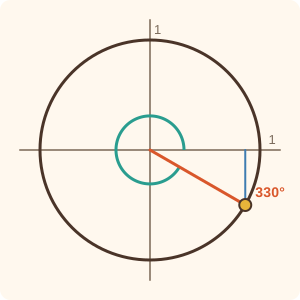
A function with f(-x) = f(x) is called even. Its graph mirrors across the y-axis. Cosine is even.
A function with f(-x) = -f(x) is called odd. Its graph turns half a turn about the origin. Sine and tangent are odd.
Periodicity: the turn
Adding 360°, which is 2π, brings the point back to where it started. So sin(x + 2π) = sin x and cos(x + 2π) = cos x.
The period of sine and cosine is 2π. Tangent repeats sooner: tan(x + π) = tan x, from Tuesday's through-the-center rule.
So tan has period π. For example tan 210° = tan 30° = √3/3, and tan 405° = tan 45° = 1.
To find a value past one turn, subtract 360° until the angle lands between 0° and 360°, then read the circle.
| Function | f(-x) | Even or odd | Period |
|---|---|---|---|
| sine | -sin x | odd | 2π (360°) |
| cosine | cos x | even | 2π (360°) |
| tangent | -tan x | odd | π (180°) |
- ?Angle x lands at P = (cos x, sin x)
- ?Angle -x turns the same amount clockwise and lands at Q
- ?Q is the reflection of P across the x-axis
- ?So Q = (cos x, -sin x)
- ?But Q = (cos(-x), sin(-x)) by definition
- ?Match coordinates: cos(-x) = cos x and sin(-x) = -sin x
- Read the question.
- Tap your answer.
What is cos(-30°)? Cosine is even.- Read the question.
- Tap your answer.
| Statement | True or false? |
|---|---|
| cos(-x) = cos x, so cosine is even. | ? |
| sin(-x) = sin x, so sine is even. | ? |
| sin(x + 360°) = sin x for every angle x. | ? |
| The period of tangent is 360°. | ? |
| sin 390° = 1/2. | ? |
Clear reasoning. Tomorrow the whole week comes back in a mixed set from the Boathouse log.