Monday
Monday: Two Families of Liquids
Rocket lines up four cups on the Bench. Vinegar, lemon juice, baking soda stirred into water, and a squirt of dish soap in water.
"Two of these fizzed with baking soda in week 7," he says. "Vinegar and lemon juice. So they are the same kind of thing."
Raven dips a clean finger in the soap water and rubs her thumb. "What do you notice? This one is slippery. The baking soda water is a little slippery too."
"So the other two are a second kind," Rocket says. "Fizzers and slipperies."
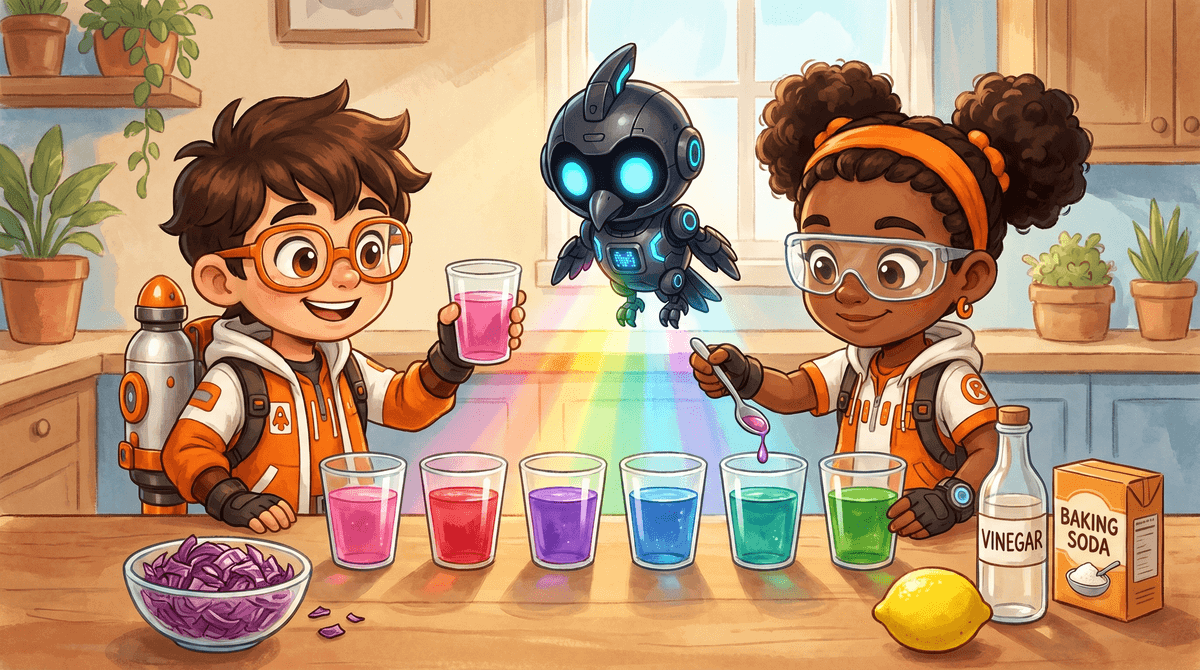
Nova hovers between the cups, her light shifting from red to blue. "Chemists have names for your two families," she says. "And a purple vegetable that can tell them apart."
Raven writes two headings in the Bench Log and leaves a space for the vegetable.
Acids
Acids are common in some of the foods we eat. Citrus fruits such as oranges and lemons contain citric acid. Vinegar contains acetic acid.
Acids are a distinct class of compounds because of the properties of their watery solutions.
Acids change the color of certain acid-base indicators. Blue litmus paper turns red in the presence of an acid.
Acids react with bases to produce a salt and water. Chemists call this neutralizing the acid.
Acids also taste sour, but tasting chemicals is not good lab practice. Nothing is tasted at the Bench, ever.
Bases
Bases have properties that mostly contrast with those of acids. Litmus turns blue in the presence of a base.
Many bases, like soaps, are slippery to the touch. Bases are found in foods less often than acids.
Antacids, which fight excess stomach acid, are made of bases such as sodium hydrogen carbonate. That is the chemical name for baking soda.
Many cleaners contain ammonia, a base, and drain cleaner contains sodium hydroxide. Those never come to the Bench. Kitchen bases only.
Bases react with acids to produce a salt and water.
| Property | Acids | Bases |
|---|---|---|
| Found in | Vinegar (acetic acid), lemons and oranges (citric acid) | Soaps, baking soda (sodium hydrogen carbonate) |
| Litmus paper | Blue litmus turns red | Litmus turns blue |
| Feel | Not slippery | Often slippery |
| React with | Bases, making a salt and water | Acids, making a salt and water |
- Read the question.
- Tap your answer.
| Statement | True or false? |
|---|---|
| Blue litmus turns red in an acid. | ? |
| Bases are usually slippery. | ? |
| An acid and a base react to make a salt and water. | ? |
| Drain cleaner is safe to test at the Bench. | ? |
| Tasting is a good way to test for an acid. | ? |
Write which one felt slippery in your Bench Log. Wash your hands again when you finish.
Only kitchen materials are used. Never household cleaners, bleach, ammonia or drain cleaner, and never two products mixed.
A grown-up chops the cabbage and pours the hot water on Wednesday. Cabbage juice stains, so cover the Bench.
Acid, base and indicator facts this week come from the CK-12 chemistry text at chem.libretexts.org and the USGS Water Science School (usgs.gov).
Good sorting. Tomorrow you will meet the pH scale, the measuring stick for acids and bases.