Monday
Monday: Where Did the Fizz Go?
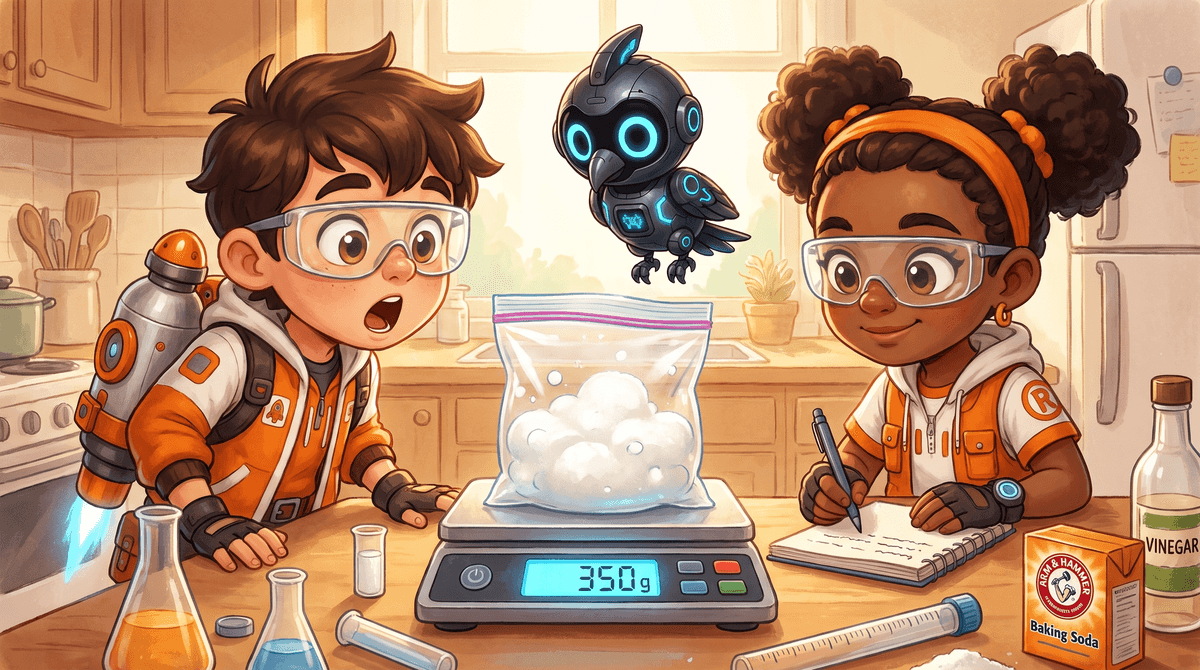
Rocket sets a cup of vinegar on the kitchen scale and writes down the number. Then he adds a spoon of baking soda.
The cup foams. The number on the scale drops, slowly, one gram at a time.
"It is disappearing!" he says. "The matter is going away."
Raven leans over the scale. "What do you notice? The foam is popping, and something is leaving the cup."
"The gas," Rocket says. "The carbon dioxide. But gas is nothing."
Nova hovers above the cup, her light steady. "Is a gas nothing?" she asks. "Think about the bag of air you weighed in week 2."
Rocket stops. "Gas has mass. So the mass did not vanish. It floated off."
Raven writes the question in the Bench Log: if we trap the gas, does the number stay the same?
What mass is
Mass is a measure of the amount of matter that an object contains. In a laboratory, mass is measured with a balance.
The base unit of mass is the kilogram. There are 1000 grams in a kilogram, so a kitchen scale that reads in grams is measuring mass.
Mass is often confused with weight. Weight is the pull of gravity on an object, and it depends on where you are.
Mass depends only on the amount of matter present, so it does not change with location.
The law of conservation of mass
In normal chemical processes, we cannot create or destroy matter. This is the law of conservation of mass.
If we start out with ten carbon atoms, we need to end up with ten carbon atoms.
Atoms are neither created nor destroyed during a chemical change. They are rearranged to make substances that are different from the ones before.
If atoms are not created or destroyed, then the total mass of matter stays constant when one substance changes into another.
Why the open cup seemed to lose mass
Baking soda and vinegar react and produce carbon dioxide gas. A gas fills its container, taking both the shape and the volume of the container.
An open cup has no lid, so the gas floats out into the room. Its mass leaves with it.
The matter did not vanish. It moved. Trap the gas, and the scale should not change at all.
- Read the question.
- Tap your answer.
| Statement | True or false? |
|---|---|
| Mass is measured with a balance. | ? |
| A gas has no mass. | ? |
| Atoms are rearranged, not destroyed, in a chemical reaction. | ? |
| Ten carbon atoms in means ten carbon atoms out. | ? |
| Mass changes when you move to a different place. | ? |
Add one spoon of water. Read the mass in grams. Add a second spoon and read it again.
Write both numbers in your Bench Log. Did the mass go up by about the same amount each time?
A kitchen scale that reads in grams is ideal. Without one, a ruler balanced on a pencil works as a seesaw balance.
Bags are sealed with only a little air, so they puff but do not burst. Safety glasses go on. The work stays on a tray.
Definitions this week come from the CK-12 chemistry text hosted by Chemistry LibreTexts, at chem.libretexts.org.
Good thinking. Tomorrow you will see how atoms regroup, and why that means the mass cannot change.