Monday
Monday: Three States at the Bench
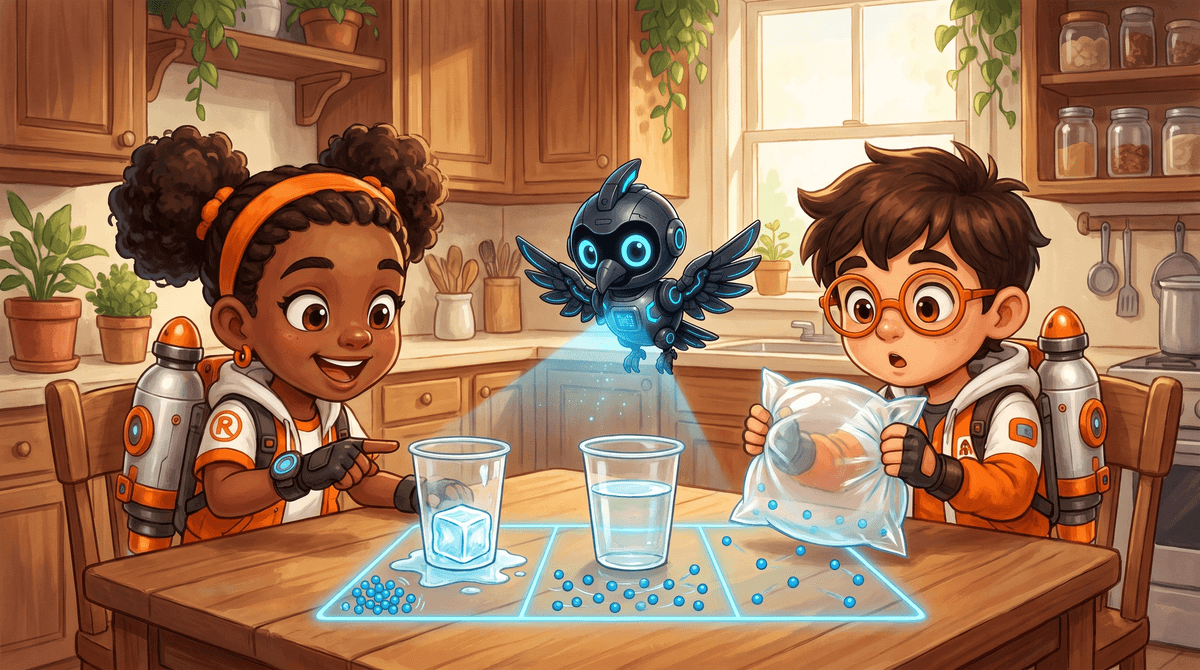
Rocket sets three things on the Bench. There is an ice cube on a plate, a cup of water and a zip bag puffed up with air.
"Same stuff, three ways," he says. "Well, two of them are water. The bag is air."
Raven tips the cup a little, and the water leans with it. The ice cube does not budge. "What do you notice?"
"The water moves and the ice does not," Rocket says. He squeezes the bag, and it squashes flat in his hand, then puffs back.
Nova hovers over the plate, where the ice cube is already shining with a thin ring of water. "Watch the edge," she says. "Something is changing while you talk."
"It is turning into the second kind," Rocket says. "Ice to water. But what makes them different?"
Raven writes three headings in the Bench Log: Solid, Liquid, Gas.
Three normal states
Matter normally exists as either a solid, a liquid or a gas. Scientists call this property of matter its phase, or its state.
Water shows all three. Below 0 degrees Celsius, water is a solid called ice. Between 0 and 100 degrees Celsius it is a liquid.
Above 100 degrees Celsius, water becomes a gas called water vapor. Every substance can exist in any of the three states.
A change of state is a physical change, not a chemical change. A molecule of water vapor is still H2O, the same as liquid water or ice.
How to tell the states apart
A solid holds its shape, and its volume is fixed by that shape. Push an ice cube around a plate and it stays a cube.
A liquid takes the shape of its container, with a free surface on top. Regardless of the container, a liquid keeps a fixed volume.
A gas fills its container, taking both the shape and the volume of the container. Let a gas into a bigger bag and it spreads to fill it.
Liquids and gases are called fluids, because they can be made to flow.
| State | Shape | Volume | Everyday example |
|---|---|---|---|
| Solid | Keeps its own shape | Fixed | An ice cube, a spoon, a grain of salt |
| Liquid | Takes the shape of its container | Fixed | Water, vinegar, cooking oil |
| Gas | Takes the shape of its container | Fills the whole container | The air in a zip bag, water vapor |
- Read the question.
- Tap your answer.
| Statement | True or false? |
|---|---|
| A solid keeps its own shape. | ? |
| A liquid has no fixed volume. | ? |
| A gas takes the shape and the volume of its container. | ? |
| Water above 100 degrees Celsius is a gas called water vapor. | ? |
| Ice and water vapor are different chemicals. | ? |
- Tap a card.
- Then tap its spot.
What do you notice? Write in your Bench Log which one changed shape and which one did not.
Ice cubes come from the freezer; a grown-up handles any hot water or kettle if steam is discussed.
The state facts this week come from NASA Glenn, the Next Generation Science Standards and LibreTexts chemistry.
Good sorting. Tomorrow you will shrink down to the size of a particle and see why the states behave so differently.