Wednesday
Wednesday: Multiply decimals
Bruce sets three bags of river stones on a flat rock.
"Each bag has 1.25 kilograms of stones," he says. "How much do all three bags hold?"
Bennie counts the bags. "That is 3 groups of 1.25, so I can multiply."
Then Bruce points to a small garden patch marked with string.
"This patch is 0.3 meter long and 0.2 meter wide," he says.
"What is its area?" Bennie smiles slowly.
"A tenth of a tenth is a hundredth," he says. "Let me show you why."
Learn it: a whole number times a decimal
3 × 1.25 means 3 groups of 1.25.
1.25 + 1.25 + 1.25 = 3.75.
Or think in hundredths: 1.25 is 125 hundredths.
3 × 125 hundredths = 375 hundredths, which is 3.75.
- Read the question.
- Tap your answer.
Learn it: a decimal times a decimal
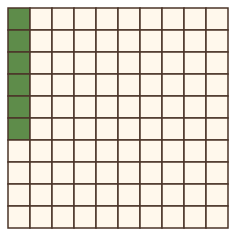
0.3 × 0.2 means 3 tenths of 2 tenths.
One tenth of a tenth is one hundredth.
So 3 tenths of 2 tenths is 3 × 2 = 6 hundredths.
So 0.3 × 0.2 = 0.06 square meter.
Here is a written method for 2.4 × 0.3.
Multiply as whole numbers: 24 × 3 = 72.
2.4 has one decimal place, and 0.3 has one. That makes two places.
So 2.4 × 0.3 = 0.72.
Check with an estimate: 2.4 is close to 2, and 0.3 of 2 is 0.6. So 0.72 makes sense.
- Read the question.
- Tap your answer.
- Read the question.
- Tap your answer.
- Think about the written method.
- Tap the steps in order.
| Sentence | True or false? |
|---|---|
| 0.3 × 0.2 = 0.6 | ? |
| 3 × 1.25 = 3.75 | ? |
| 0.5 × 0.7 = 0.35 | ? |
| 10 × 0.4 = 0.04 | ? |
Multiply to predict how far 4 steps will take you.
Now take 4 steps and measure with a tape measure.
Was your prediction close?
Super multiplying! Tomorrow Chris tells a story about dividing.