Tuesday
Tuesday: Multiply to find equal fractions
Riley spreads a puzzle on a flat stump. It is cut into 4 equal pieces.
"I have 3 of the 4 pieces," he says. "That is 3/4."
Then he cuts every piece into 2 smaller pieces.
"Now there are 8 pieces, and I have 6 of them."
Bennie nods. "You doubled the parts, so you doubled the pieces you have."
"The numerator and the denominator were both multiplied by 2."
"So 3/4 = 6/8," says Riley. "Same puzzle, smaller pieces!"
Learn it: multiply the top and bottom
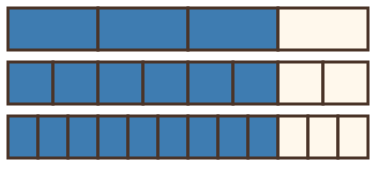
Split each fourth into 2 parts: 3/4 = (3 × 2)/(4 × 2) = 6/8.
Split each fourth into 3 parts: 3/4 = (3 × 3)/(4 × 3) = 9/12.
Multiplying both numbers by the same number gives an equivalent fraction.
It works because each part is split the same way.
| Multiply by | Fraction |
|---|---|
| 2 | (1 × 2)/(2 × 2) = 2/4 |
| 3 | (1 × 3)/(2 × 3) = 3/6 |
| 4 | (1 × 4)/(2 × 4) = 4/8 |
| 5 | (1 × 5)/(2 × 5) = 5/10 |
| 6 | (1 × 6)/(2 × 6) = 6/12 |
All of these are equal to 1/2.
- Read the question.
- Tap your answer.
- Read the question.
- Tap your answer.
- Read the question.
- Tap your answer.
Learn it: tenths and hundredths
Multiply by 10 to turn tenths into hundredths.
3/10 = (3 × 10)/(10 × 10) = 30/100.
- Read the question.
- Tap your answer.
- Think about how Riley splits the parts.
- Tap the steps in order.
| Sentence | True or false? |
|---|---|
| 3/4 = 9/12 | ? |
| 3/10 = 30/100 | ? |
| 2/3 = 3/4 | ? |
| 5/6 = 10/12 | ? |
Now fold it in half again, the same way.
Count all the parts and the colored parts.
Write the two equal fractions you made.
Same puzzle, smaller pieces! Tomorrow we compare fractions.