Monday
Monday: Remainders
Oliver the Owl adjusts his round glasses and opens a basket of berries.
"Good morning," he says. "I have 29 berries for 4 of my friends."
"Each friend should receive the same number. How shall we share them?"
Bennie the Bear starts making four piles, one berry at a time.
Soon each pile has 7 berries, and one berry sits alone.
"Hmm," says Oliver. "One berry cannot be split into four equal piles."
Bennie smiles. "That one is the remainder. It is what is left over."
Learn it: quotient and remainder
4 × 7 = 28, and 4 × 8 = 32. The 8 is too many.
So each friend gets 7 berries, and 29 - 28 = 1 is left.
We write 29 ÷ 4 = 7 R 1. The R stands for remainder.
The 7 is the quotient. The 1 is the remainder.

A remainder is always less than the divisor. If it were not, we could share more.
- Read the question.
- Tap your answer.
 Share 29 berries among 4 friends. How many are left over?
 Share 17 shells among 5 friends. How many are left over?
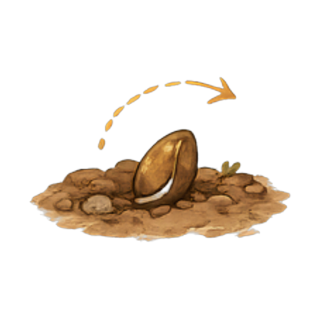 Share 45 seeds into 7 pots. How many are left over?
 Share 38 leaves among 6 friends. How many are left over?
- Read the question.
- Tap your answer.
Learn it: divide tens, hundreds and thousands
8 ÷ 4 = 2, so 8 tens ÷ 4 = 2 tens. That is 80 ÷ 4 = 20.
800 ÷ 4 = 200, and 8,000 ÷ 4 = 2,000.
The basic fact stays the same. Only the place changes.
- Read the question.
- Tap your answer.
- Think about how Bennie shares the berries.
- Tap the steps in order.
| Sentence | True or false? |
|---|---|
| A remainder must be less than the divisor. | ? |
| 30 ÷ 5 = 6 | ? |
| 6 × 7 + 3 = 45 | ? |
| 42 ÷ 6 = 8 | ? |
Share them into 5 equal piles, one at a time.
How many are in each pile? How many are left over?
Check: 23 ÷ 5 = 4 R 3.
Well shared! Tomorrow we divide three-digit numbers, part by part.