Week 04 · Factors, multiples and patterns
Wednesday
Prime and composite
// Factor pairs, primes and number rules
⏱ about 15 min
Wednesday: Prime and composite
Samantha has 7 acorns left after lunch.
She tries to make equal rows, like she did with 24.
"Two rows? No, one acorn is left over," she says.
"Three rows? No again!"
She tries and tries, but only one long row of 7 works.
Bennie peeks over. "That is because 7 is a prime number."
"Its only factors are 1 and 7. It cannot make any other rectangle."
Samantha grins. "Then 24 must be the other kind!"
Learn it: prime or composite?
A prime number has exactly two factors: 1 and itself.
7 is prime. Its factors are 1 and 7.
A composite number has more than two factors. 24 has 8 factors.
The number 1 has only one factor, so it is neither prime nor composite.

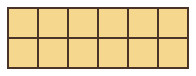
7 makes only one rectangle. 12 makes more than one, so 12 is composite.
PRIME OR COMPOSITE?
- Read the question.
- Tap your answer.
Is 7 prime or composite?
Is 12 prime or composite?
Is 13 prime or composite?
Is 1 prime or composite?
FIND THE ONE
- Read the question.
- Tap your answer.
Which number is prime?
Which number is prime?
Which number is prime?
Which number is prime?
THINK ABOUT IT
- Read the question.
- Tap your answer.
How many factors does 23 have?
How many factors does 25 have?
Is 2 prime or composite?
Which number is composite?
PRIME NUMBERS UP TO 12, IN ORDER
- Find the numbers with exactly two factors.
- Tap them from least to greatest.
11st
22nd
33rd
44th
55th
Count the factors of each number.
| Sentence | True or false? |
|---|---|
| 7 is a prime number. | ? |
| 9 is a prime number. | ? |
| 51 is a composite number. | ? |
| 1 is a prime number. | ? |
WHY THIS EXERCISE9 = 3 × 3, so 9 has 3 factors and is composite.
Try it
Take 11 small things, like beans or pebbles.
Try to arrange them in equal rows of 2, 3 and 4.
Does any way work besides one long row?
What does that tell you about 11?
Try to arrange them in equal rows of 2, 3 and 4.
Does any way work besides one long row?
What does that tell you about 11?
Draw every rectangle you can make with 7 squares and with 12 squares.
Wonderful work! Tomorrow Chris tells a story about patterns.