Week 04 · Missing numbers
Wednesday
Turn around and group
// Unknowns, turn-arounds and break-aparts
⏱ about 15 min
Wednesday: Turn around and group
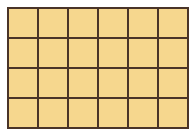
Samantha sets out acorns in an array: 4 rows of 6.
Then she spins around to look from the side.
"Now I see 6 rows of 4!" she squeaks.
"Did my acorns change?"
Bennie laughs kindly. "No, it is the same array."
"So 4 × 6 and 6 × 4 make the same product."
"That is a turn-around fact," says Samantha.
Learn it: turn-around facts
This grid shows 4 rows of 6. That is 4 × 6 = 24.
Turn it on its side. Now it shows 6 rows of 4. That is 6 × 4 = 24.
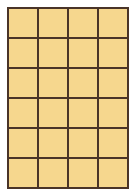
Changing the order of the factors does not change the product.
If you know 4 × 6, you also know 6 × 4.
Learn it: group the factors
Three factors can be grouped in either way.
Try 3 × 5 × 2.
First 3 × 5 = 15. Then 15 × 2 = 30.
Or first 5 × 2 = 10. Then 3 × 10 = 30.
Making a 10 first is often easier.
USE THE TURN-AROUND FACT
- Read the question.
- Tap your answer.
6 × 4 = 4 × ?7 × 3 = ? × 7
9 × 2 = 2 × ?
8 × 5 = 40. What is 5 × 8?
GROUP THE FACTORS
- Read the question.
- Tap your answer.
3 × 5 × 2 = ?
2 × 4 × 5 = ?
5 × 2 × 7 = ?
Which way makes 2 × 5 × 9 easier?
WHICH IS THE SAME?
- Read the question.
- Tap your answer.
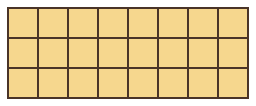 Which has the same product as 3 × 8?
Which has the same product as 6 × 7?
Which has the same product as (4 × 2) × 5?
Find the value of each side.
| Sentence | True or false? |
|---|---|
| 4 × 6 = 6 × 4 | ? |
| 3 × 5 × 2 = 3 × 10 | ? |
| 7 × 2 = 7 + 2 | ? |
| 2 × 9 × 5 = 9 × 10 | ? |
WHY THIS EXERCISE7 × 2 = 14, but 7 + 2 = 9.
Try it
Build an array of 2 rows of 5 with spoons or blocks.
Walk around to the side and look again.
Say the multiplication you see now.
Did the number of things change?
Walk around to the side and look again.
Say the multiplication you see now.
Did the number of things change?
On paper, draw 3 rows of 5 dots. Then draw 5 rows of 3. Write both facts.
Terrific turning! Tomorrow Chris tells a break-apart story.