Thursday
Thursday: The Diagonal That Never Ends
Rocket draws a 1 by 1 tile on the floor plan and a diagonal across it. "Brace length. One squared plus one squared."
"Two," Raven says. "So the brace is √2. What do you notice when you look for a number that squares to 2?"
"One squared is 1. Two squared is 4. It is between 1 and 2." Rocket tries 1.4. "1.96. Close. 1.5 is 2.25. Too big."
He tries 1.41. "1.9881." Then 1.414. "1.999396. It keeps getting closer but never lands!"
Nova hovers over the tile, her light flickering along the diagonal. "It never lands," she says. "No fraction squares to 2."
"A number that is not a fraction?" Rocket says. Nova hums. "Irrational. You can still place it on a number line."
Square roots that are not whole
The diagonal of a square tile with side s is √(s² + s²) = √(2s²). For a 1 by 1 tile, that is √2.
No whole number squares to 2, so √2 is not whole. It sits between 1 and 2 because 1² = 1 and 2² = 4.
Squeeze it: 1.4² = 1.96 and 1.5² = 2.25, so √2 is between 1.4 and 1.5. Then 1.41² = 1.9881, so it is just past 1.41.
No fraction squares to exactly 2. The decimal of √2 never ends and never repeats. It is irrational.
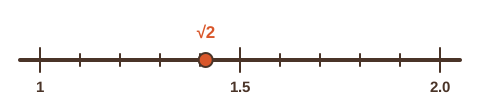
Placing roots on the number line
- Find the two perfect squares on either side of the number. For 10: 9 and 16.
- The root sits between their roots. √10 is between 3 and 4.
- Test tenths: 3.1² = 9.61 and 3.2² = 10.24. So √10 is between 3.1 and 3.2, closer to 3.2.
- Mark it on the number line, and write it to one decimal place: about 3.2.
These are the crew's own tile sizes from the floor plan, in units, with each diagonal to one decimal place.
| Tile side | Side² + side² | Diagonal |
|---|---|---|
| 1 | 2 | √2 ≈ 1.4 |
| 2 | 8 | √8 ≈ 2.8 |
| 5 | 50 | √50 ≈ 7.1 |
- Read the question.
- Tap your answer.
√2 is between which two whole numbers?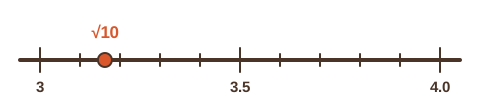 √10 is between which two whole numbers?
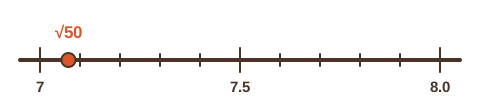 √50 is between which two whole numbers?
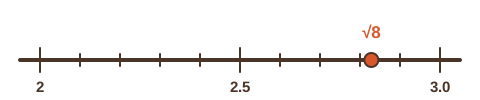 The 2 by 2 tile has diagonal √8. Between which two whole numbers is √8?
- Read the question.
- Tap your answer.
Which decimal is closest to √2?Which decimal is closest to √10?The 5 by 5 tile has diagonal √50. Which decimal is closest to √50?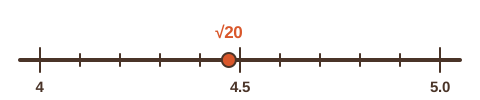 Which decimal is closest to √20?
- Read the question.
- Tap your answer.
Now a 2 by 2 square. Its diagonal is √8. Is your measurement close to 2.8?
√2 has a place on the line but no fraction. Tomorrow repeating decimals turn back into fractions, and the course review begins.