Monday
Monday: The Ladder Makes a Triangle
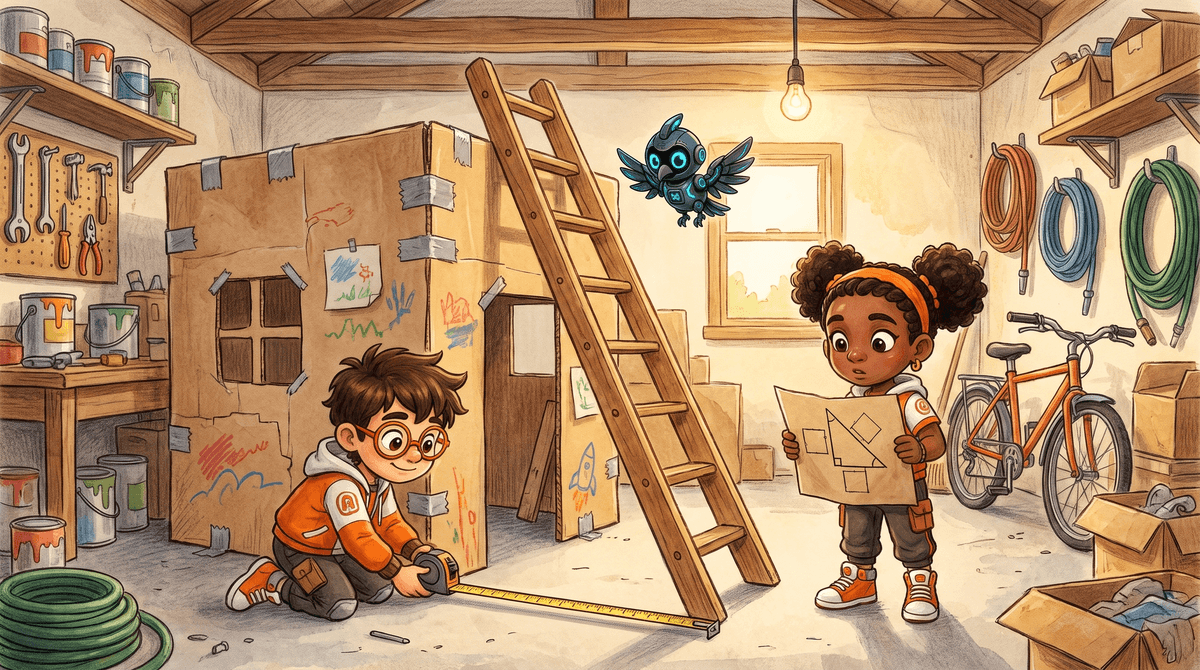
Rocket leans a straw ladder against the model clubhouse wall. "The roof crew needs a way up. How long should it be?"
"What do you notice about the shape it makes?" Raven asks. She points at the wall, the floor and the straw.
"A triangle with a square corner where the wall meets the floor," Rocket says. "The ladder is the slanted side."
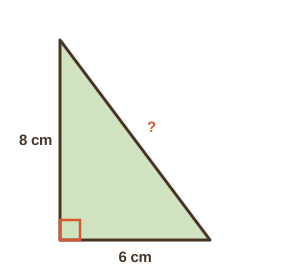
Raven measures twice. "The foot is 6 centimeters from the wall. The top is 8 centimeters up."
Nova hovers at the square corner, her light drawing a square on each side of the triangle. "Count the areas," she says.
Rocket sketches squares of 36 and 64 on the two short sides. "And the big one on the ladder?"
Nova hums. "Add the two small squares first. Then tell me the ladder."
Legs, hypotenuse and the squares
A right triangle has one square corner. The two sides that meet there are the legs, a and b.
The side across from the square corner is the hypotenuse, c. It is always the longest side.
Draw a square on each side. The two leg squares together have the same area as the hypotenuse square.
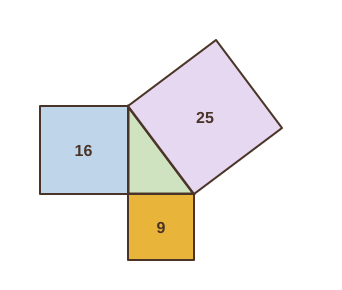
That is the Pythagorean theorem: a² + b² = c². With legs 3 and 4: 9 + 16 = 25, so c = 5.
The crew's ladder: legs 6 and 8. 36 + 64 = 100, and the square root of 100 is 10. The ladder is 10 cm.
Finding the hypotenuse
- Square each leg: a × a and b × b.
- Add the two squares.
- Take the square root of the sum. That is c.
- Check: c must be longer than either leg, but shorter than the two legs added.
- Read the question.
- Tap your answer.
- Read the question.
- Tap your answer.
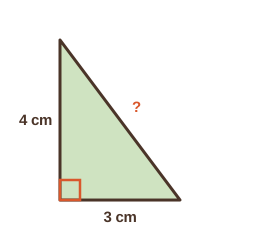 A right triangle has legs 3 and 4 cm. How long is the longest side, in centimeters?The ladder's foot is 6 cm from the wall and its top is 8 cm up. How long is the ladder, in cm?
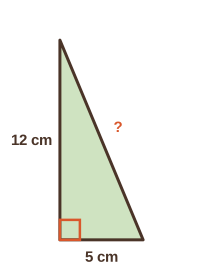 A right triangle has legs 5 and 12 cm. How long is the longest side, in centimeters?
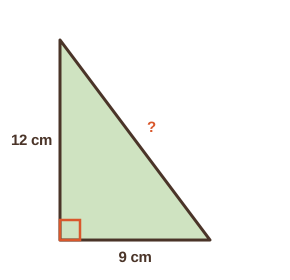 A right triangle has legs 9 and 12 cm. How long is the longest side, in centimeters?
| Statement | True or false? |
|---|---|
| The hypotenuse is the longest side of a right triangle. | ? |
| The legs meet at the square corner. | ? |
| In a right triangle, a + b = c. | ? |
| The squares on the two legs together equal the square on the hypotenuse. | ? |
Square both numbers, add, and take the square root. Then measure the ruler to check. No real ladders: look only.
Two legs gave the ladder. Tomorrow four triangles in a square show why the rule always works.