Wednesday
Wednesday: Build Lab, Flatten and Measure
Raven lines up three empty boxes on the Blueprint Table. "Build Lab. Predict the surface area, then unfold and measure."
"Measure the three edges first," Rocket says. "Length, width, height. Then I can predict before I cut."
"And after you cut?" Raven asks. "What do you notice we can check?"
"Every rectangle in the net," Rocket says. "Six of them. If each one matches, the prediction stands."
Nova hovers above the first box, her light on its longest edge. "Measure twice," she says. "Cardboard does not forgive."
Rocket reads the tape. "Ten, six, four." He writes the prediction, then picks up the scissors. "Two hundred forty-eight. Watch."
Your mission
Measure the three edges of a small box and predict its surface area. Then unfold it into a net and measure every face to check. Finish with a paper pyramid.
- Two or three small empty boxes, thin cardboard, clean and dry.
- A ruler or tape measure, scissors, tape, a pencil and paper.
- Your Blueprint Book for the data table.
Cut away from your fingers. Put scissors down closed between cuts, and pick up every scrap afterwards.
- Measure the length, width and height of the first box in centimeters. Measure each one twice.
- Predict the surface area: find the three face areas, double each, and add. Write it down.
- Cut along edges with scissors until the box lies flat in one piece. Trace the net on paper.
- Measure every rectangle in the net. Find each area and add all six. Compare with your prediction.
- Draw a pyramid net: an 8 cm square with a triangle 6 cm tall on each side. Predict its area, then cut and fold it.
The crew's lab table
These are the crew's own box measurements and face areas, from Raven's Blueprint Book, in centimeters.
| Face | Edges (cm) | Area (sq cm) | How many | Total (sq cm) |
|---|---|---|---|---|
| Top and bottom | 10 by 6 | 60 | 2 | 120 |
| Front and back | 10 by 4 | 40 | 2 | 80 |
| Two ends | 6 by 4 | 24 | 2 | 48 |
| Whole net | 6 | 248 |
Rocket's prediction was 248 square centimeters, and the six measured faces added to the same total.
The paper pyramid had an 8 cm square and 6 cm triangles. Its net: 64 + 4 × 24 = 160 square centimeters.
- Read the question.
- Tap your answer.
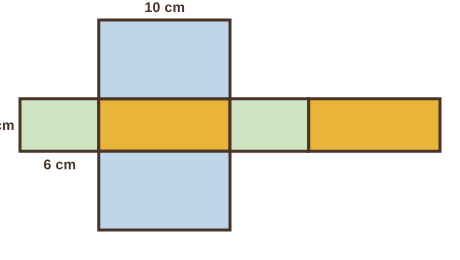 The lab box is 10 by 6 by 4 cm. What is its surface area in square centimeters?
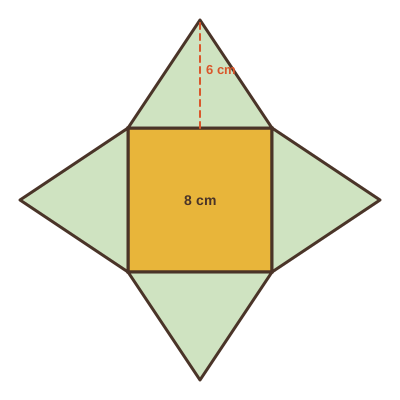 The paper pyramid has an 8 cm square base and 6 cm triangles. What is the area of its net?
| What the lab shows | True or false? |
|---|---|
| The six measured faces added to the predicted surface area. | ? |
| 2 × 60 + 2 × 40 + 2 × 24 = 248 | ? |
| Measuring the three edges once is enough for cardboard. | ? |
Every face measured and matched. Tomorrow the crew counts the cardboard sheets for the whole clubhouse.