Week 03 · Nets and Surface Area
Build Day
Build Day: The box at home
// Unfold a box, add up its faces
⏱ about 20 min
Build Day: The Box at Home
Saturday morning the family gathers at the kitchen table with a stack of empty boxes.
"Build Day," Raven says. "Each person picks a box, measures its edges, and predicts its surface area."
"Then we unfold one and check every face," Rocket says. "Mine first. It is the biggest."
"What do you notice about which faces are the same?" Raven asks.
"Opposite faces match," Rocket's cousin says. "So I only need three multiplications."
Nova hovers above the table, her light counting the boxes. "Predict before you cut," she says. "Every time."
Rocket is already measuring. "Twelve, twelve, twelve. A cube!" Nova hums. "Then one multiplication, times six."
- A net is a solid unfolded flat. The surface area of the solid is the area of its net.
- A box has six faces in three matching pairs: surface area = 2 × (top + front + end).
- A cube has six equal squares: 6 × side × side.
- A square pyramid has a square base and four equal triangles: base + 4 × (½ × base × height).
- Count only the faces you cover. Round up to whole sheets when you cut cardboard.
◇ UNFOLD A BOX TOGETHER
Each person picks an empty box and measures its length, width and height in centimeters. Measure twice.
Predict the surface area: three face areas, each doubled, then added. Write it in the Blueprint Book.
Choose one box to unfold. A grown-up cuts any thick cardboard with scissors; thin boxes you can cut yourself.
Measure every face of the net and add them. Compare with the prediction.
Fold the net back into a box and tape it. Then compare all the family's surface areas.
Predict the surface area: three face areas, each doubled, then added. Write it in the Blueprint Book.
Choose one box to unfold. A grown-up cuts any thick cardboard with scissors; thin boxes you can cut yourself.
Measure every face of the net and add them. Compare with the prediction.
Fold the net back into a box and tape it. Then compare all the family's surface areas.
For a grown-up
This week your student learned to unfold boxes and pyramids into nets and add the faces for surface area.
Ask them why a box needs only three multiplications. The answer should mention matching pairs of faces.
Cut thick cardboard yourself, with scissors, never a craft blade. Keep the table clear of scraps.
Ask them why a box needs only three multiplications. The answer should mention matching pairs of faces.
Cut thick cardboard yourself, with scissors, never a craft blade. Keep the table clear of scraps.
Safety first
Scissors only, with a grown-up nearby. A grown-up cuts thick or stiff cardboard.
Cut away from fingers, set scissors down closed, and pick up every scrap afterwards.
Cut away from fingers, set scissors down closed, and pick up every scrap afterwards.
BUILD DAY CHECK
- Read the question.
- Tap your answer.
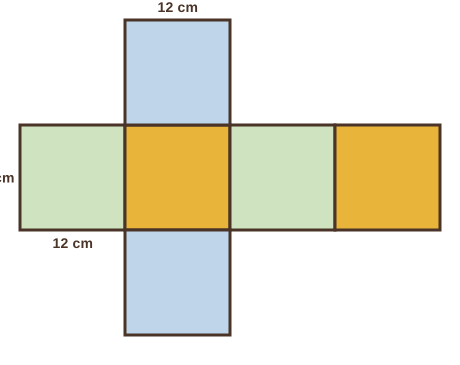 Rocket's box is a cube 12 cm on each edge. What is its surface area in square centimeters?
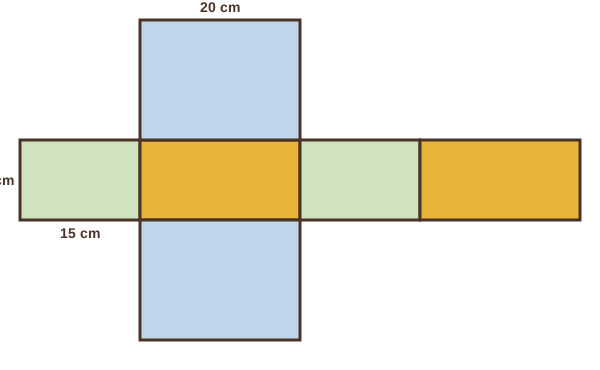 Raven's box is 20 by 15 by 10 cm. What is its surface area in square centimeters?
Raven's box is 20 by 15 by 10 cm. What is the area of its top face?
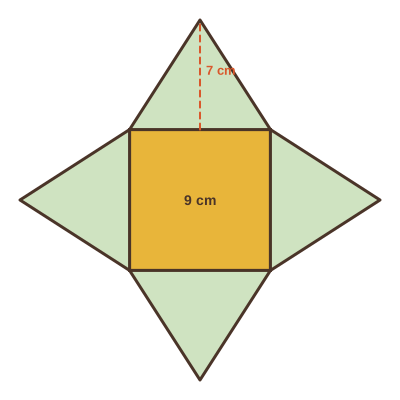 The cousin's paper roof has a 9 cm base and 7 cm triangles. What is the area of its whole net?
Matching faces mean fewer multiplications. A cube has only one face size.
| Build Day check | True or false? |
|---|---|
| Opposite faces of a box are the same size. | ? |
| A cube's surface area needs six different multiplications. | ? |
| Folding a net back up gives the solid again. | ? |
WHY THIS EXERCISEUnfolding a real box shows that surface area is cardboard you can hold, not only a number.
Draw the net of the box your family unfolded, every face labeled with its edges and area.
Great unfolding, crew. Next week: pack a box with cubes and find out how much the storage bin holds.