Monday
Monday: Unfold the Box
Rocket sets a small cardboard box on the Blueprint Table. "The clubhouse is a box. How much cardboard covers it?"
"Measure every face," Raven says. "But faces are hard to measure when they stand up."
Rocket cuts along four edges with the scissors and presses the box flat. Six rectangles spread out like a cross.
"A net," Raven says. "What do you notice about the rectangles?"
"They come in pairs," Rocket says. "Top and bottom match. Front and back match. The two ends match."
Nova hovers above the flattened box, her light landing on each pair in turn. "Three pairs," she says. "Three multiplications. Then double each."
"Four by two, four by three, two by three," Rocket says, already writing. "Eight, twelve, six. Doubled, fifty-two."
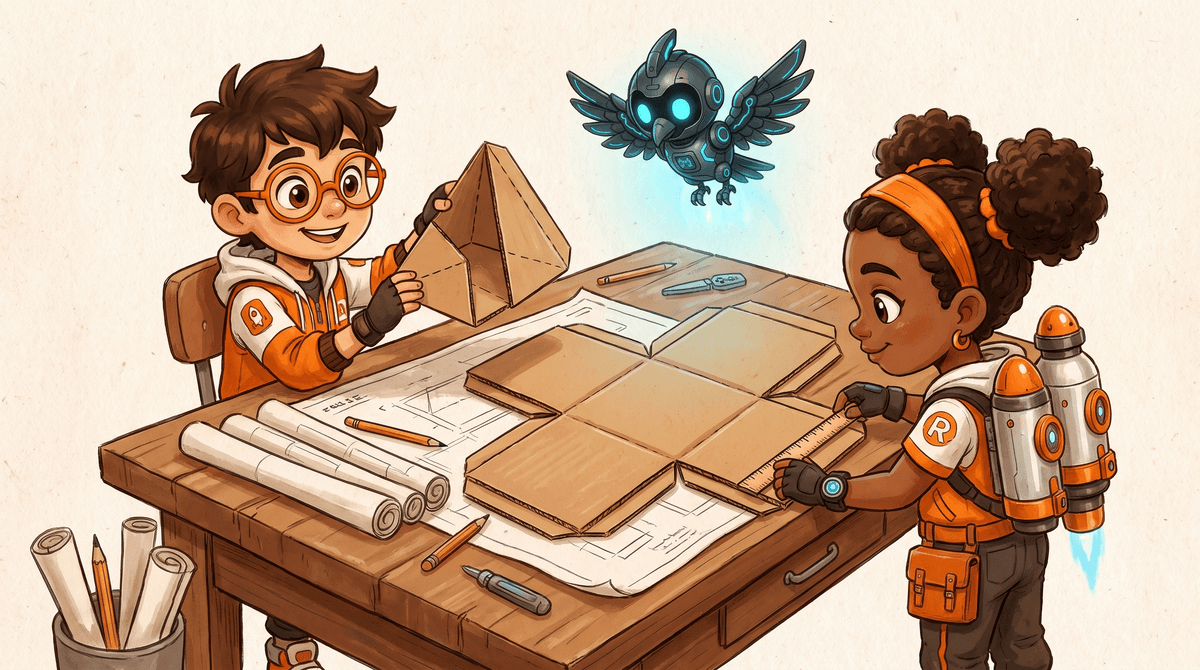
A net is a solid laid flat
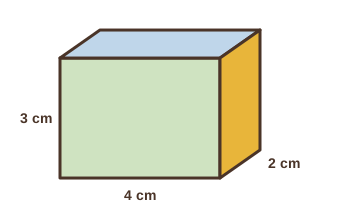
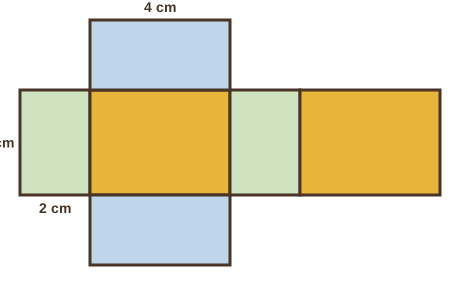
Cut a box along some of its edges and unfold it. The flat shape is its net. Every face of the box is one rectangle of the net.
A box is a rectangular prism. It has six faces in three matching pairs: top and bottom, front and back, the two ends.
Fold the net back up along its creases and the box returns. The net and the box are the same cardboard.
Surface area is the area of the net
This box is 4 cm long, 2 cm wide and 3 cm tall. Top and bottom: 4 × 2 = 8 each. Front and back: 4 × 3 = 12 each.
The two ends: 2 × 3 = 6 each. Add all six faces: 2 × 8 + 2 × 12 + 2 × 6 = 52 square centimeters.
That total is the surface area: all the cardboard it takes to cover the box. It is an area, so the unit is square centimeters.
- Read the question.
- Tap your answer.
What is the surface area in square centimeters?- Read the question.
- Tap your answer.
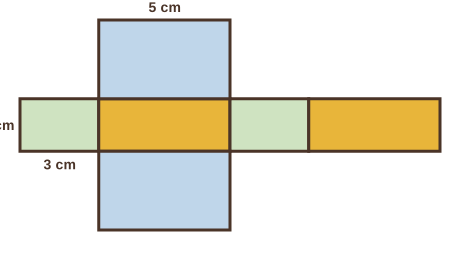 What is the surface area in square centimeters?
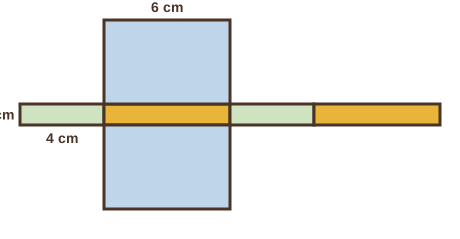 What is the surface area in square centimeters?
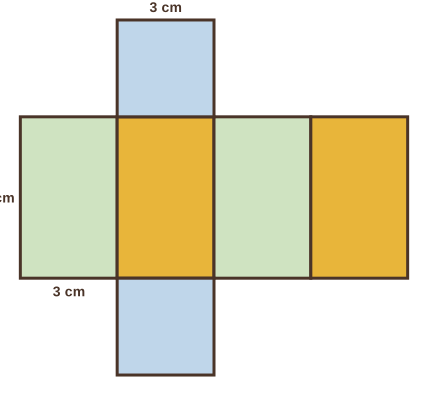 What is the surface area in square centimeters?
| Statement | True or false? |
|---|---|
| A net is a solid shape unfolded flat. | ? |
| A box has eight faces. | ? |
| The faces of a box come in three matching pairs. | ? |
| 2 × 8 + 2 × 12 + 2 × 6 = 52 | ? |
Trace around the net on paper. Count the faces and mark the matching pairs with the same letter.
Cut away from your fingers, and put scissors down closed between cuts.
Six faces, three pairs, one total. Tomorrow a pyramid unfolds into a square and four triangles.