Build Day
Build Day: The Family Grid
Saturday morning the family kneels on the hallway floor with a roll of masking tape.
"Build Day," Raven says. "Tape a grid, name the corners, and string a polygon from coordinates."
"Each square is one floor tile," Rocket says. "The origin is by the door."
"What do you notice about where the string will turn?" Raven asks.
"At every vertex," Rocket says. "And every wall is a subtraction if the corners share a number."
Nova hovers above the origin, her light marking (0, 0). "Call out each coordinate before the string moves," she says.
Rocket's cousin reads the first corner. "(0, 0) to (4, 0)." The string stretches four tiles. Nova hums. "Four. Measured by numbers."
- A point's coordinates are (x, y): across from the origin, then up or down.
- A polygon is drawn by plotting its vertices and joining them in order.
- Two vertices with the same x make a vertical side; the same y makes a horizontal side. Subtract the other coordinates for the length.
- Subtraction works across zero: 4 - (-3) = 7. The four quadrants go counterclockwise from the upper right.
- Add the sides for the perimeter. Decompose into rectangles and triangles for the area.
One person writes four to six coordinates for a polygon with horizontal and vertical sides.
Another person strings or draws the polygon, calling out each coordinate before moving.
Everyone predicts each side length by subtracting. Then count the tiles or squares to check.
Find the perimeter and the area together, and record both in the Blueprint Book.
Ask them how long the side from (2, 1) to (7, 1) is and why. The answer should mention the shared y.
Keep tape flat and string low so nobody trips. Pick up every piece afterwards.
Shoes on. Walk, never run, across the grid.
- Read the question.
- Tap your answer.
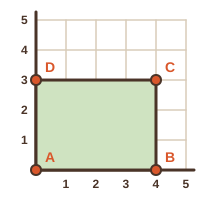 The family's rectangle has corners (0, 0), (4, 0), (4, 3), (0, 3). What is its perimeter in tiles?How many tiles does the family's rectangle enclose?
| Build Day check | True or false? |
|---|---|
| Calling out each coordinate before moving the string helps catch a slip. | ? |
| A polygon with five vertices has five sides. | ? |
| The side from (0, 0) to (4, 0) is vertical. | ? |
Great building, crew. Next week: unfold a box into a net, and find out how much cardboard the walls need.