Monday
Monday: Cut and Slide
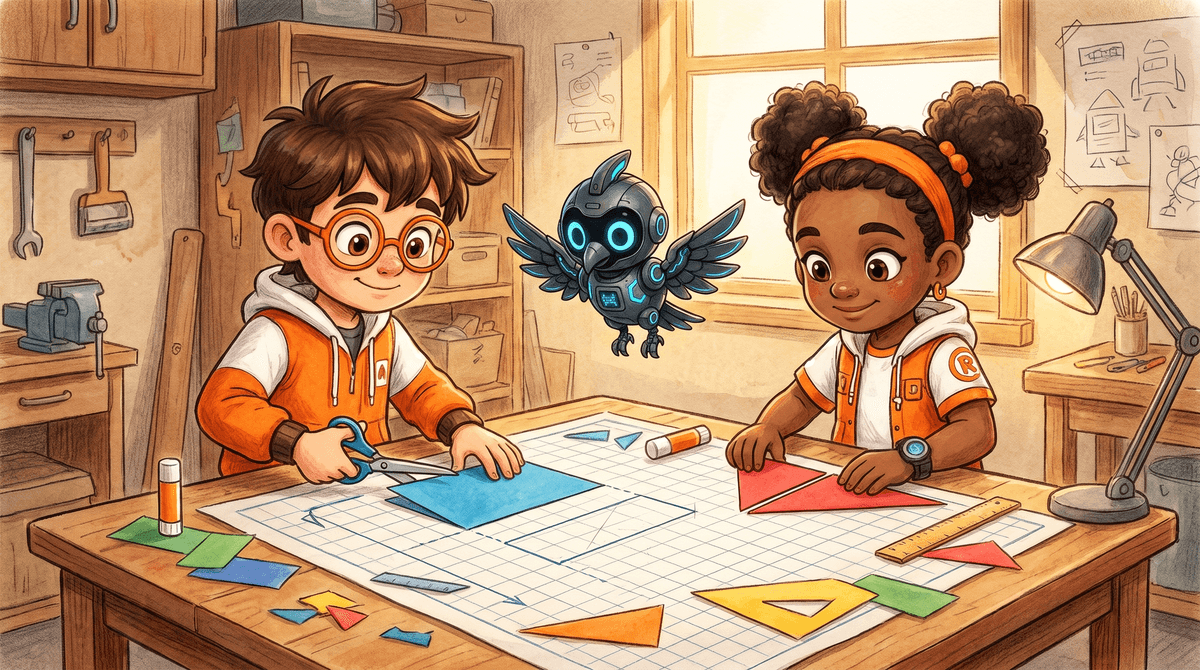
Rocket slaps a sheet of grid paper on the Blueprint Table. "The clubhouse floor. I drew it as a parallelogram."
"A slanted floor?" Raven asks. "How many squares does it cover? That is the cardboard we need."
Rocket starts counting squares along the slanted edge and groans. "Half squares everywhere."
Raven picks up the scissors. "What do you notice if we cut straight down from this corner?"
Rocket cuts along the height. A triangle falls off. Raven slides it to the other side.
"A rectangle," Rocket says. "Six squares long, four tall. Twenty-four. No half squares at all."
Nova hovers above the taped-together shape, her light tracing the cut line. "Same paper," she says. "Same area. Only the shape moved."
Area is squares covered
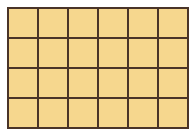
Area is the number of unit squares a shape covers. This rectangle has 4 rows of 6 squares, so its area is 4 × 6 = 24 square units.
A square centimeter is a square 1 cm on each side. A floor that covers 24 of them has an area of 24 square centimeters.
Rows times columns is a shortcut for counting. Area formulas are all shortcuts for counting squares, and this week shows why each one works.
Units matter
Length is measured in centimeters or meters. Area is measured in square centimeters or square meters, because you are counting squares.
The model clubhouse is measured in centimeters, so its floor areas are in square centimeters. A real room would be in square meters.
A parallelogram becomes a rectangle
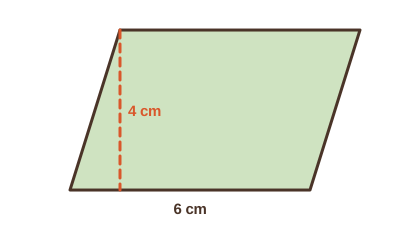
Cut a parallelogram straight down along its height. Slide the cut-off triangle to the other end. The pieces make a rectangle.
The rectangle has the same base and the same height, and the same paper. So the area of a parallelogram is base × height.
This one has base 6 cm and height 4 cm. Area = 6 × 4 = 24 square centimeters.
The height is the straight-across distance, not the slanted side. Rocket learned that the slow way, by counting half squares.
- Read the question.
- Tap your answer.
What is the area of the parallelogram in square centimeters?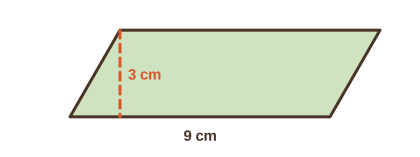 What is the area of the parallelogram in square centimeters?
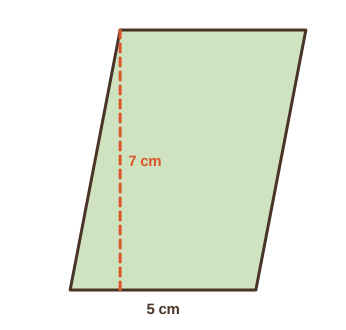 What is the area of the parallelogram in square centimeters?
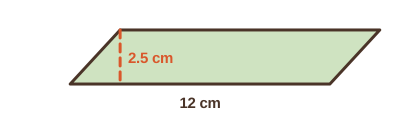 What is the area of the parallelogram in square centimeters?
| Statement | True or false? |
|---|---|
| Cutting a shape and sliding the pieces changes its area. | ? |
| The area of a parallelogram is base × height. | ? |
| The height of a parallelogram is its slanted side. | ? |
| 6 × 4 = 24 | ? |
Cut straight down from one top corner and slide the triangle to the other side. Count the squares in your rectangle.
Scissors go back on the table, closed, when you are done cutting.
Cut, slide, count. Tomorrow a triangle turns out to be half of a parallelogram, and a trapezoid is two triangles.