Thursday
Thursday: The Lamp Dish
Wren lays the lamp reflector on the bench, a shallow dish. "Why this shape? It is not a circle."
"Every point of the dish bounces light to one spot," Comet says. "The bulb sits there. What can we make of it?"
"A rule," Wren says. "Put the bottom of the dish at the origin and the bulb at (0, 2). What do you notice?"
Nova projects a dashed line two units below the origin. "Would you like a hint? Every dish point is as far from the bulb as from this line."
Comet measures on the grid. "(4, 2) is 4 from the bulb and 4 from the line. (8, 8) is 10 and 10."
"So distance to the point equals distance to the line," Wren says. "Write it with the distance formula."
"It shrinks down to y = x²/8," Comet says. "Our designer, check the crew's dish numbers."
A parabola from a point and a line
A parabola is the set of points equally far from a fixed point, the focus, and a fixed line, the directrix.
The crew puts the vertex at the origin, the focus at (0, p) and the directrix at y = -p. For the lamp dish, p = 2.
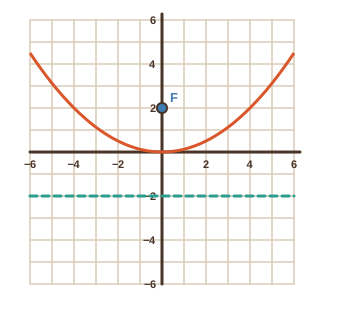
A solved problem to study
Comet derives the equation. Take any point (x, y) on the curve.
Distance to the focus (0, p): the square root of x² + (y - p)². Distance to the directrix y = -p: y + p.
Set them equal and square both sides: x² + (y - p)² = (y + p)². Multiply out: x² + y² - 2py + p² = y² + 2py + p².
The y² and p² cancel. What is left is x² = 4py, so y = x²/(4p). For p = 2, y = x²/8.
Dividing by 8 is the same as multiplying by 0.125, so the crew also writes it as y = (0.125)x².
Why does this work? Squaring both sides keeps the equal distances equal, and the messy terms cancel on their own.
The crew's dish readings
Every number here is the crew's own measurement of the lamp dish on the grid, with p = 2.
| x | y = x²/8 | Distance to the focus | Distance to the directrix |
|---|---|---|---|
| 0 | 0 | 2 | 2 |
| 2 | 0.5 | 2.5 | 2.5 |
| 4 | 2 | 4 | 4 |
| 6 | 4.5 | 6.5 | 6.5 |
| 8 | 8 | 10 | 10 |
The last two columns match in every row. That is the definition of a parabola, checked point by point.
- Read the question.
- Tap your answer.
The lamp dish has its vertex at (0, 0), focus (0, 2) and directrix y = -2. What is its equation?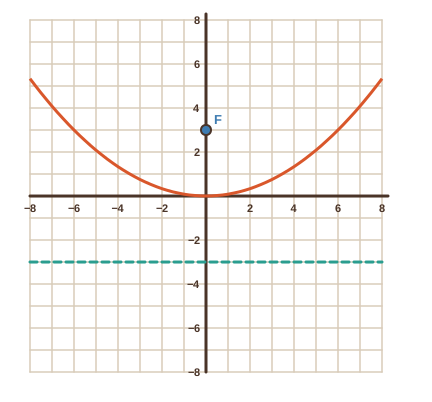 A second lamp dish has focus (0, 3) and directrix y = -3. What is its equation?
- Read the question.
- Tap your answer.
How far is the dish point (4, 2) from the focus (0, 2)?For one point, measure to F and to the line with a ruler. Are they the same?
Sharp thinking, designer. Tomorrow you find circles and parabolas around you and review the week.