Wednesday
Wednesday: Shop Lab, Angles on a Cardboard Circle
Comet sets a sheet of cardboard, a pencil, string, a protractor and a carpenter's square on the bench. "Lab day."
"Three arcs, three rim points each," Wren says. "If the inscribed angles come out equal, the rule holds."
Comet draws a big circle with the string compass and marks the center. "Arc one: eighty degrees."
She marks three points on the far rim and measures. "Thirty-nine. Forty. Forty-one. Close enough for chalk."
"What does the evidence say?" Wren asks. "Half of eighty is forty, and your readings sit around forty."
Nova projects a right angle sitting on the rim. "Would you like a hint? Try the carpenter's square with its corner on the circle."
Comet sets the square's corner on the rim. Its two edges cross the circle at two points. "They are the ends of a diameter!"
What you need
- A sheet of cardboard or thick paper, a pencil and about 20 centimeters of string. A grown-up holds the pin.
- A protractor, a ruler and a carpenter's square, or the corner of a hardcover book.
- Scissors if you want to trim the cardboard. Your Shop Book.
Cut cardboard with scissors only, sitting down. Nothing sharp is used.
The carpenter's square has corners; carry it flat and set it down gently.
Run the lab
- Draw a circle with a string compass and mark its center O. Make the radius at least 8 centimeters.
- Mark two rim points B and C so the central angle BOC is 80°. Check with the protractor.
- Mark three points on the far side of the rim. At each, measure the angle to B and to C.
- Repeat for central angles of 120° and 150°. Record every reading in a table.
- Set the square's corner on the rim. Mark where its edges cross the circle. Draw a line between those marks.
- Does that line pass through O? Try two more spots on the rim.
The crew's lab log
Here are the crew's own readings from their cardboard circle. All made-up Scene Shop data, measured to the nearest degree.
| Central angle (arc) | Rim point 1 | Rim point 2 | Rim point 3 | Half the arc |
|---|---|---|---|---|
| 80° | 39° | 40° | 41° | 40° |
| 120° | 59° | 60° | 61° | 60° |
| 150° | 74° | 75° | 76° | 75° |
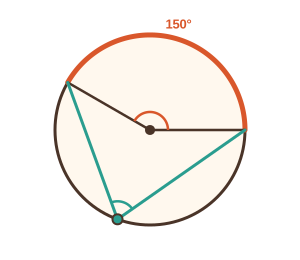
Every rim reading lands within a degree of half the arc. A protractor on cardboard is not perfect, but the pattern is clear.
The carpenter's square test worked too: the two crossing points were always the ends of a diameter.
That is the angle in a semicircle, run backwards. A right angle on the rim always sits on a 180° arc.
- Read the question.
- Tap your answer.
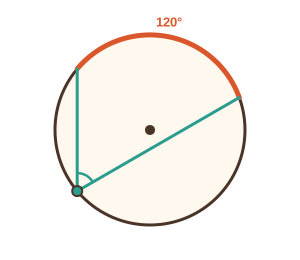 For the 120° arc, what inscribed angle should the crew expect at every rim point, in degrees?
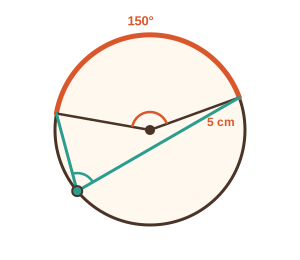 The crew's rim readings for the third arc sat around 75°. What was the central angle, in degrees?
| What the lab shows | True or false? |
|---|---|
| Moving the rim point along the far arc changed the inscribed angle. | ? |
| Each inscribed angle came out close to half the central angle. | ? |
| A right angle with its corner on the rim cuts the circle at the ends of a diameter. | ? |
| The readings were exact to a tenth of a degree. | ? |
Where they cross is the center. Check with a ruler that the center is equally far from the rim.
Fine lab work, designer. Tomorrow is Proof Day: you see exactly why the rim angle is half the arc.