Monday
Monday: Every Circle Is the Same Circle
Comet ties chalk to one end of a string and pins the other end to the stage floor. "Turntable. Radius 3 meters."
She walks the chalk around. A clean circle appears under the spotlight.
"Look," Wren says, pointing at the floor. "The spotlight makes its own circle. Radius about 1 meter. What do you notice?"
"It is our circle, shrunk," Comet says. "Same shape, 3 times smaller."
Nova projects the small circle growing from its center until it matches the chalk. "Would you like a hint? That growth is a dilation."
"A dilation from the center, scale factor 3," Wren says. "So the two circles are similar. Every pair of circles is."
"Six spokes next," Comet says. "Our designer, how many degrees between spokes? Then let us measure this thing."
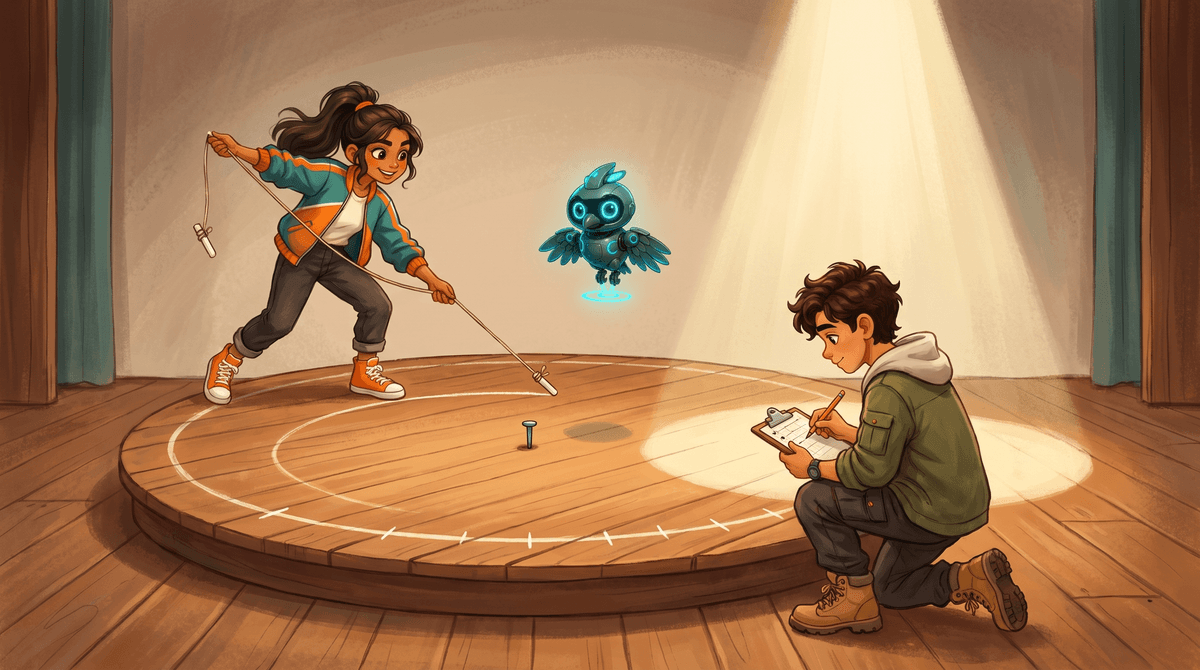
Why all circles are similar
Two figures are similar when a sequence of rigid motions and dilations carries one onto the other (week 5).
Slide one circle so its center sits on the other's center. Then dilate from that center by big radius ÷ small radius.
Every point at the small radius moves to the big radius. The small circle lands exactly on the big one.
For the spotlight pool and the turntable, the scale factor is 3 ÷ 1 = 3. Circumference and radius scale by 3; area scales by 3².
The parts of a circle
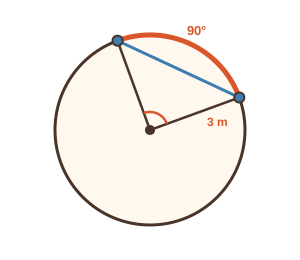
| Part | What it is | On the turntable |
|---|---|---|
| radius | a segment from the center to the circle | the string, pinned at the center |
| diameter | a chord through the center, twice the radius | a line across through the pin |
| chord | a segment with both ends on the circle | a brace laid across the platform |
| arc | a piece of the circle between two points | the rim between two spokes |
| central angle | an angle with its vertex at the center | the angle between two spokes |
| tangent | a line touching the circle at one point | the straightedge resting against the rim |
A central angle and its arc have the same measure in degrees. A full turn is 360°, so the whole circle is a 360° arc.
A solved problem to study
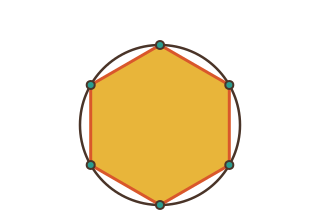
Comet wants 6 spokes, equally spaced. Here is her work.
The spokes split the full 360° at the center into 6 equal central angles: 360 ÷ 6 = 60°.
To mark them she keeps the string at the radius and steps it around the rim, as in week 1. Six steps fit exactly.
Why does this work? Each step makes a triangle with two radii and a 60° angle. That triangle is equilateral, so its third side equals the radius.
Now measure the turntable. Use 3.14 for π: circumference = 2 × π × radius and area = π × radius².
- Read the question.
- Tap your answer.
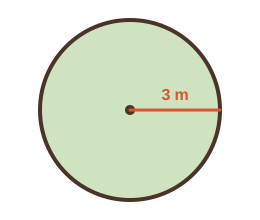 The turntable has radius 3 meters. What is its circumference in meters? Use 3.14 for π.The turntable has radius 3 meters. What is its area in square meters? Use 3.14 for π.
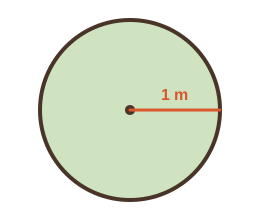 The spotlight pool has radius 1 meter. What is its circumference in meters? Use 3.14 for π.
- Read the question.
- Tap your answer.
| Statement | True or false? |
|---|---|
| Any two circles are similar. | ? |
| A diameter is a chord. | ? |
| A central angle is bigger than the arc it cuts off. | ? |
| A tangent crosses the circle at two points. | ? |
| 360 ÷ 6 = 60 | ? |
Keep the string the same length and step it around the rim. Count the steps. Join the marks.
Good start, designer. Tomorrow angles move from the center to the rim, and a brace gets measured without a tape.