Thursday
Thursday: Proof Day, the Altitude and the Pythagorean Theorem
Wren sets a right-triangle brace on the bench, legs 6 and 8. He drops a string from the square corner straight down to the long side.
"The altitude to the hypotenuse. It makes two little right triangles. What do you notice?"
Comet turns the brace. "Each little one has a right angle and shares an angle with the big one. AA, both of them."
"So both little triangles are similar to the big one," Wren says. "And to each other."
Nova projects the three triangles in a row, lined up by their matching angles. "Would you like a hint? Write the proportions."
"Six over ten equals the little piece over six. Eight over ten equals the other piece over eight."
"Add the two pieces," Wren says. "They make the hypotenuse. Our designer, finish the proof."
The altitude to the hypotenuse
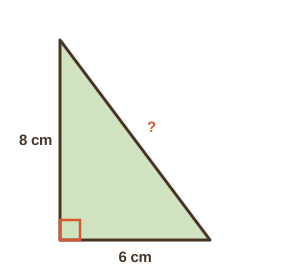
The brace has legs a = 6 and b = 8 and hypotenuse c = 10 cm. The altitude from the right angle meets the hypotenuse and splits it into two pieces. Call them p, next to a, and q, next to b.
Each small triangle has a right angle and shares one acute angle with the big triangle. By AA, each is similar to the big one.
Proof: a² + b² = c²
- Given: a right triangle with legs a and b, hypotenuse c, and the altitude from the right angle to the hypotenuse.
- The altitude splits the hypotenuse into p, next to leg a, and q, next to leg b. So p + q = c.
- The small triangle on side a is similar to the whole triangle by AA, so a over c equals p over a. Then a² = c × p.
- The small triangle on side b is similar to the whole triangle by AA, so b over c equals q over b. Then b² = c × q.
- Add the two equations: a² + b² = c × p + c × q. Factor: c × (p + q) = c × c = c².
The crew's brace numbers
Every number below is computed from the two legs with the proportions in the proof.
| Part | Length (cm) | How |
|---|---|---|
| leg a | 6 | measured |
| leg b | 8 | measured |
| hypotenuse c | 10 | square root of a² + b² |
| piece p | 3.6 | a² ÷ c |
| piece q | 6.4 | b² ÷ c |
| altitude h | 4.8 | a × b ÷ c |
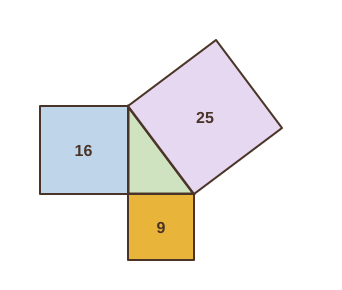
The squares on the sides show the same fact as areas: the two small squares together fill the big one. The proof above explains why.
- ?Given: a right triangle with legs a and b and hypotenuse c
- ?Draw the altitude from the right angle; it splits c into p and q
- ?Each small triangle is similar to the whole one by AA
- ?From the proportions, a² = c × p and b² = c × q
- ?Add them: a² + b² = c × (p + q) = c²
- Read the question.
- Tap your answer.
The brace has legs 6 and 8 cm. How long is its hypotenuse, in centimeters?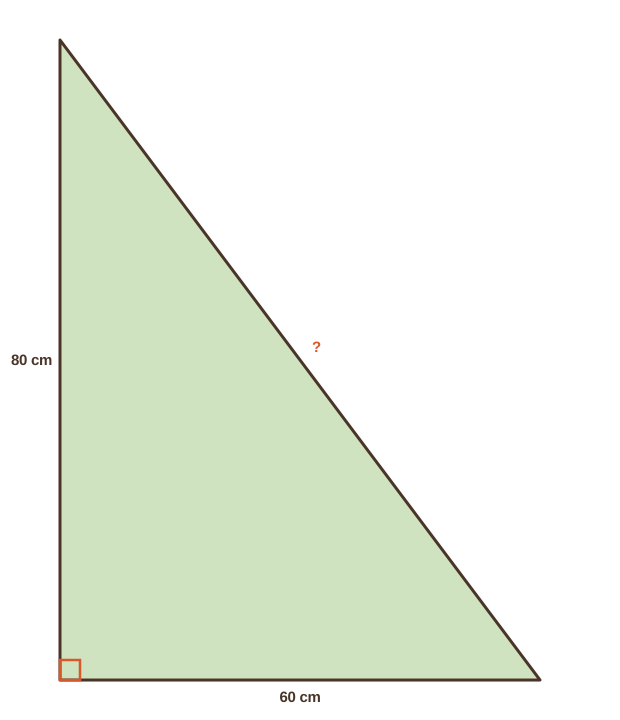 The ramp's side is a right triangle with rise 60 cm and run 80 cm. How long is its slanted edge, in centimeters?
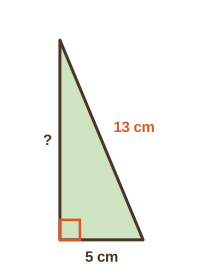 A brace has hypotenuse 13 cm and one leg 5 cm. How long is the other leg, in centimeters?
Proved, designer. Tomorrow you use congruence and similarity together on the frames and review the week.